MolDraw › Templates › General & inorganic › Chlor-alkali electrolysis of brine
General & inorganicPremium
Chlor-alkali electrolysis of brine template
Premium template. Preview and edit it free in MolDraw; downloading and exporting it is part of MolDraw Pro.
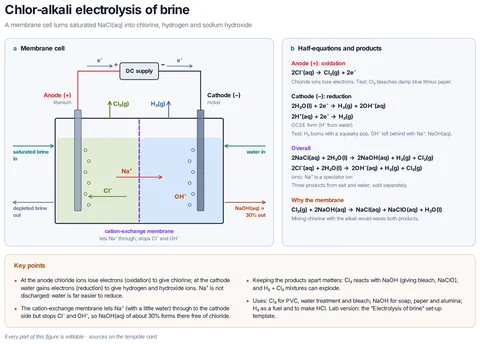
Industrial electrolysis of brine in a membrane cell for GCSE, A-level and NCERT: titanium anode (Cl₂), nickel cathode (H₂ and OH⁻), a cation-exchange membrane that passes only Na⁺, the half-equation at each electrode, the overall and ionic equations, and why the products must be kept apart.
What the template shows
- A membrane cell turns saturated NaCl(aq) into chlorine, hydrogen and sodium hydroxide
- Membrane cell
- cation-exchange membrane
- lets Na⁺ through; stops Cl⁻ and OH⁻
- saturated brine in
- depleted brine out
- NaOH(aq) ≈ 30% out
- Half-equations and products
- Anode (+): oxidation
- Chloride ions lose electrons. Test: Cl₂ bleaches damp blue litmus paper.
- Cathode (−): reduction
- GCSE form (H⁺ from water)
- Test: H₂ burns with a squeaky pop. OH⁻ left behind with Na⁺: NaOH(aq).
- 2NaCl(aq) + 2H₂O(l) → 2NaOH(aq) + H₂(g) + Cl₂(g)
- ionic: Na⁺ is a spectator ion
- Three products from salt and water, sold separately.
- Why the membrane
- Cl₂(g) + 2NaOH(aq) → NaCl(aq) + NaClO(aq) + H₂O(l)
- Mixing chlorine with the alkali would waste both products.
- At the anode chloride ions lose electrons (oxidation) to give chlorine; at the cathode water gains electrons (reduction) to give hydrogen and hydroxide ions. Na⁺ is not discharged: water is far easier to reduce.
- The cation-exchange membrane lets Na⁺ (with a little water) through to the cathode side but stops Cl⁻ and OH⁻, so NaOH(aq) of about 30% forms there free of chloride.
- Keeping the products apart matters: Cl₂ reacts with NaOH (giving bleach, NaClO), and H₂ + Cl₂ mixtures can explode.
- Uses: Cl₂ for PVC, water treatment and bleach; NaOH for soap, paper and alumina; H₂ as a fuel and to make HCl. Lab version: the "Electrolysis of brine" set-up template.
- Every part of this figure is editable · sources on the template card
Drawn with 205 shapes – every one editable in MolDraw.
Sources
How to use this template
- Press Edit in MolDraw. The template opens on the canvas of the free MolDraw editor.
- Change anything: move structures, edit atoms and labels, recolour highlights or delete what you do not need.
- Add your own structures, arrows and text next to it, or combine several templates on one page.
- Export the drawing as PNG, SVG or PDF for slides, worksheets, theses and papers.
Frequently asked questions
Is the Chlor-alkali electrolysis of brine template free?
You can preview the Chlor-alkali electrolysis of brine template here and open and edit it in MolDraw for free. Downloading or exporting it is part of MolDraw Pro, together with the other premium templates.
Can I edit the Chlor-alkali electrolysis of brine template?
Yes. It opens as an ordinary MolDraw drawing, so every structure, arrow, label and colour can be changed, and you can add your own content around it.
Is the chemistry checked?
Every structure is checked with RDKit and every curly arrow passes MolDraw’s electron-flow audit. The sources used are listed on this page.
Which MO diagrams are included?
H₂ and He₂, N₂ and O₂ (showing s–p mixing and paramagnetic O₂), and carbon monoxide.