MolDraw › Templates › General & inorganic › Extraction of iron: the blast furnace
General & inorganicPremium
Extraction of iron: the blast furnace template
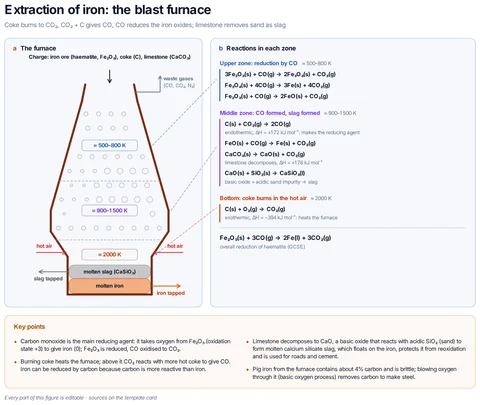
Premium template. Preview and edit it free in MolDraw; downloading and exporting it is part of MolDraw Pro.
Blast furnace for GCSE, IGCSE and NCERT Class 12: the charge (haematite, coke, limestone), hot-air blast, molten slag above molten iron, and the reactions of each temperature zone (combustion of coke, C + CO₂ → 2CO, stepwise reduction of Fe₂O₃ by CO, CaCO₃ → CaO and slag formation).
What the template shows
- Coke burns to CO₂, CO₂ + C gives CO, CO reduces the iron oxides; limestone removes sand as slag
- The furnace
- molten slag (CaSiO₃)
- molten iron
- Charge: iron ore (haematite, Fe₂O₃), coke (C), limestone (CaCO₃)
- waste gases
- slag tapped
- iron tapped
- Reactions in each zone
- Upper zone: reduction by CO
- Middle zone: CO formed, slag formed
- endothermic, ΔH = +172 kJ mol⁻¹: makes the reducing agent
- CaCO₃(s) → CaO(s) + CO₂(g)
- limestone decomposes, ΔH = +178 kJ mol⁻¹
- CaO(s) + SiO₂(s) → CaSiO₃(l)
- basic oxide + acidic sand impurity → slag
- Bottom: coke burns in the hot air
- exothermic, ΔH = −394 kJ mol⁻¹: heats the furnace
- overall reduction of haematite (GCSE)
- Carbon monoxide is the main reducing agent: it takes oxygen from Fe₂O₃ (oxidation state +3) to give iron (0); Fe₂O₃ is reduced, CO oxidised to CO₂.
- Burning coke heats the furnace; above it CO₂ reacts with more hot coke to give CO. Iron can be reduced by carbon because carbon is more reactive than iron.
- Limestone decomposes to CaO, a basic oxide that reacts with acidic SiO₂ (sand) to form molten calcium silicate slag, which floats on the iron, protects it from reoxidation and is used for roads and cement.
- Pig iron from the furnace contains about 4% carbon and is brittle; blowing oxygen through it (basic oxygen process) removes carbon to make steel.
- Every part of this figure is editable · sources on the template card
Drawn with 729 shapes – every one editable in MolDraw.
Sources
How to use this template
- Press Edit in MolDraw. The template opens on the canvas of the free MolDraw editor.
- Change anything: move structures, edit atoms and labels, recolour highlights or delete what you do not need.
- Add your own structures, arrows and text next to it, or combine several templates on one page.
- Export the drawing as PNG, SVG or PDF for slides, worksheets, theses and papers.
Frequently asked questions
Is the Extraction of iron: the blast furnace template free?
You can preview the Extraction of iron: the blast furnace template here and open and edit it in MolDraw for free. Downloading or exporting it is part of MolDraw Pro, together with the other premium templates.
Can I edit the Extraction of iron: the blast furnace template?
Yes. It opens as an ordinary MolDraw drawing, so every structure, arrow, label and colour can be changed, and you can add your own content around it.
Is the chemistry checked?
Every structure is checked with RDKit and every curly arrow passes MolDraw’s electron-flow audit. The sources used are listed on this page.
Which MO diagrams are included?
H₂ and He₂, N₂ and O₂ (showing s–p mixing and paramagnetic O₂), and carbon monoxide.