MolDraw › Templates › Resonance › Nitrobenzene
ResonancePremium
Nitrobenzene template
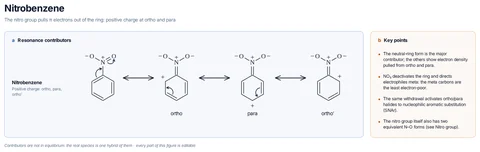
Premium template. Preview and edit it free in MolDraw; downloading and exporting it is part of MolDraw Pro.
PhNO₂: a ring π bond forms C=N as the N=O π bond moves onto O, leaving δ+ on the ortho, para and other ortho carbons.
What the template shows
- The nitro group pulls π electrons out of the ring: positive charge at ortho and para
- Resonance contributors
- Positive charge: ortho, para, ortho′
- The neutral-ring form is the major contributor; the others show electron density pulled from ortho and para.
- NO₂ deactivates the ring and directs electrophiles meta: the meta carbons are the least electron-poor.
- The same withdrawal activates ortho/para halides to nucleophilic aromatic substitution (SNAr).
- The nitro group itself also has two equivalent N–O forms (see Nitro group).
- Contributors are not in equilibrium: the real species is one hybrid of them · every part of this figure is editable
Drawn with 36 atoms, 7 arrows, 2 shapes – every one editable in MolDraw.
Sources
How to use this template
- Press Edit in MolDraw. The template opens on the canvas of the free MolDraw editor.
- Change anything: move structures, edit atoms and labels, recolour highlights or delete what you do not need.
- Add your own structures, arrows and text next to it, or combine several templates on one page.
- Export the drawing as PNG, SVG or PDF for slides, worksheets, theses and papers.
Frequently asked questions
Is the Nitrobenzene template free?
You can preview the Nitrobenzene template here and open and edit it in MolDraw for free. Downloading or exporting it is part of MolDraw Pro, together with the other premium templates.
Can I edit the Nitrobenzene template?
Yes. It opens as an ordinary MolDraw drawing, so every structure, arrow, label and colour can be changed, and you can add your own content around it.
Is the chemistry checked?
Every structure is checked with RDKit and every curly arrow passes MolDraw’s electron-flow audit. The sources used are listed on this page.
How are resonance structures shown?
Each contributor is drawn separately, joined by double-headed resonance arrows, with curly arrows showing how the electrons move from one contributor to the next.