MolDraw › Templates › Biochemistry › Maillard reaction: the Amadori rearrangement
BiochemistryPremium
Maillard reaction: the Amadori rearrangement template
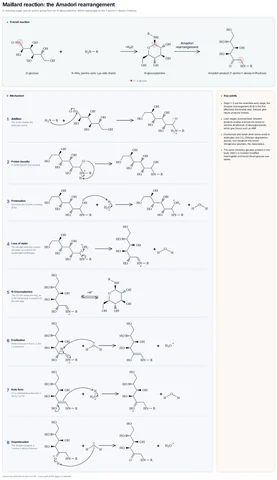
Premium template. Preview and edit it free in MolDraw; downloading and exporting it is part of MolDraw Pro.
The amine adds to the open-chain aldehyde of glucose and loses water to an iminium ion (in equilibrium with the cyclic N-glucosylamine). Loss of the C2 proton gives the 1,2-enaminol, which tautomerises to the Amadori product, the start of browning.
Mechanism step by step
A reducing sugar and an amino group form an N-glycosylamine, which rearranges to the 1-amino-1-deoxy-2-ketose
- Addition – The amine attacks the aldehyde carbon
- Proton transfer – A carbinolamine (hemiaminal)
- Protonation – Acid turns the OH into a leaving group
- Loss of water – The nitrogen lone pair pushes out water: an iminium ion (protonated Schiff base)
- N-Glucosylamine – The C5–OH closes the ring, as in the hemiacetal; it reopens for the next step
- Enolisation – Water removes H from C2: the 1,2-enaminol
- Keto form – C1 is protonated as the enol O forms C=O⁺H
- Deprotonation – The Amadori product, a 1-amino-1-deoxy-2-ketose
Key points
- Steps 1–5 are the reversible early stage; the Amadori rearrangement (6–8) is the first effectively irreversible step. Ketoses give Heyns products instead.
- Later stages (summarised): Amadori products enolise and lose the amine to reactive dicarbonyls (3-deoxyglucosone), which give furans such as HMF.
- Dicarbonyls also break down amino acids to aldehydes and CO₂ (Strecker degradation, aroma), and condense into brown nitrogenous polymers, the melanoidins.
- The same chemistry glycates proteins in the body: HbA1c is Amadori-modified haemoglobin and tracks blood glucose over weeks.
Drawn with 269 atoms, 26 arrows, 13 shapes – every one editable in MolDraw.
Sources
How to use this template
- Press Edit in MolDraw. The template opens on the canvas of the free MolDraw editor.
- Change anything: move structures, edit atoms and labels, recolour highlights or delete what you do not need.
- Add your own structures, arrows and text next to it, or combine several templates on one page.
- Export the drawing as PNG, SVG or PDF for slides, worksheets, theses and papers.
Frequently asked questions
Is the Maillard reaction: the Amadori rearrangement template free?
You can preview the Maillard reaction: the Amadori rearrangement template here and open and edit it in MolDraw for free. Downloading or exporting it is part of MolDraw Pro, together with the other premium templates.
Can I edit the Maillard reaction: the Amadori rearrangement template?
Yes. It opens as an ordinary MolDraw drawing, so every structure, arrow, label and colour can be changed, and you can add your own content around it.
Is the chemistry checked?
Every structure is checked with RDKit and every curly arrow passes MolDraw’s electron-flow audit. The sources used are listed on this page.
Are the biochemical pathways drawn with structures?
Yes. Pathway templates show the intermediates as structures, with enzymes and cofactors (NAD⁺, FAD, ATP) on the arrows.