MolDraw › Templates › Biochemistry › DNA base pairs
BiochemistryPremium
DNA base pairs template
Premium template. Preview and edit it free in MolDraw; downloading and exporting it is part of MolDraw Pro.
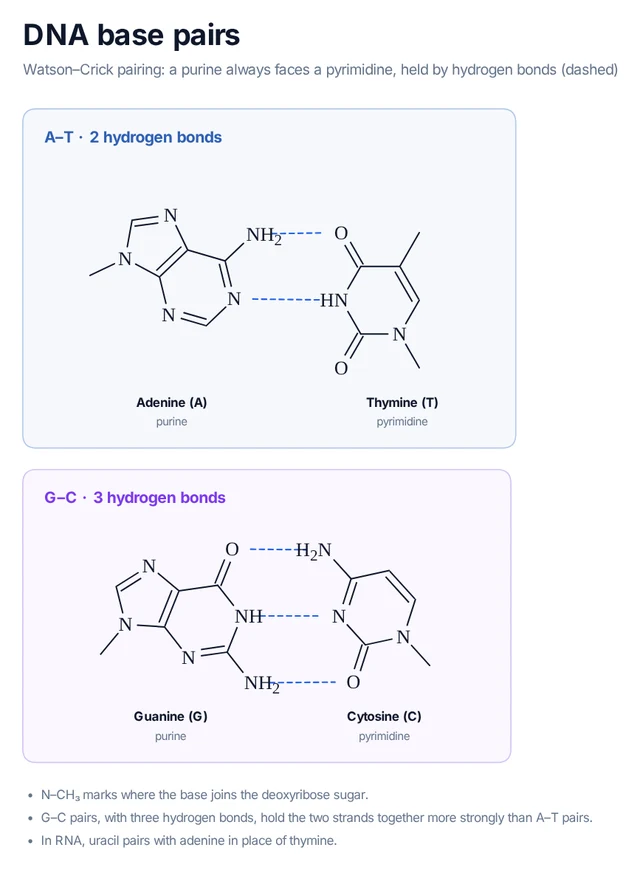
Watson–Crick A–T (two hydrogen bonds) and G–C (three hydrogen bonds) pairs with the H-bonds drawn.
What the template shows
- Watson–Crick pairing: a purine always faces a pyrimidine, held by hydrogen bonds (dashed)
- A–T · 2 hydrogen bonds
- G–C · 3 hydrogen bonds
- N–CH₃ marks where the base joins the deoxyribose sugar.
- G–C pairs, with three hydrogen bonds, hold the two strands together more strongly than A–T pairs.
- In RNA, uracil pairs with adenine in place of thymine.
Drawn with 42 atoms, 38 shapes – every one editable in MolDraw.
Sources
How to use this template
- Press Edit in MolDraw. The template opens on the canvas of the free MolDraw editor.
- Change anything: move structures, edit atoms and labels, recolour highlights or delete what you do not need.
- Add your own structures, arrows and text next to it, or combine several templates on one page.
- Export the drawing as PNG, SVG or PDF for slides, worksheets, theses and papers.
Frequently asked questions
Is the DNA base pairs template free?
You can preview the DNA base pairs template here and open and edit it in MolDraw for free. Downloading or exporting it is part of MolDraw Pro, together with the other premium templates.
Can I edit the DNA base pairs template?
Yes. It opens as an ordinary MolDraw drawing, so every structure, arrow, label and colour can be changed, and you can add your own content around it.
Is the chemistry checked?
Every structure is checked with RDKit and every curly arrow passes MolDraw’s electron-flow audit. The sources used are listed on this page.
Are the biochemical pathways drawn with structures?
Yes. Pathway templates show the intermediates as structures, with enzymes and cofactors (NAD⁺, FAD, ATP) on the arrows.