MolDraw › Templates › Lab reference cards › Reagent quick table
Reagent quick table template
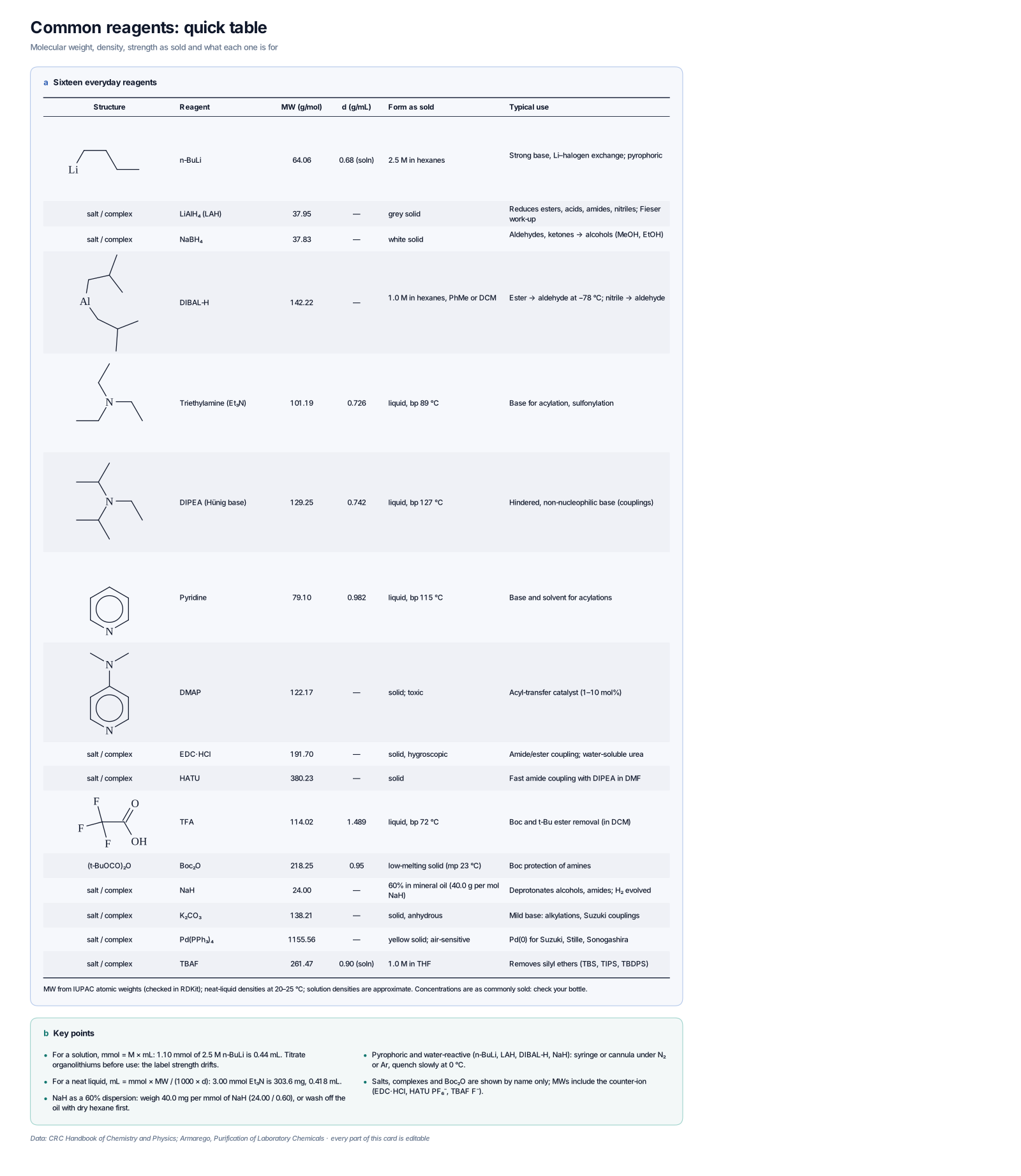
Free template. Download it, or open it in MolDraw to change it first.
Sixteen everyday reagents (n-BuLi, LiAlH₄, NaBH₄, DIBAL-H, Et₃N, DIPEA, pyridine, DMAP, EDC·HCl, HATU, TFA, Boc₂O, NaH, K₂CO₃, Pd(PPh₃)₄, TBAF) with MW, density, form as sold and typical use.
What the template shows
- Common reagents: quick table
- Molecular weight, density, strength as sold and what each one is for
- Sixteen everyday reagents
- Form as sold
- Typical use
- Strong base, Li–halogen exchange; pyrophoric
- salt / complex
- LiAlH₄ (LAH)
- grey solid
- Reduces esters, acids, amides, nitriles; Fieser work-up
- white solid
- Aldehydes, ketones → alcohols (MeOH, EtOH)
- 1.0 M in hexanes, PhMe or DCM
- Ester → aldehyde at −78 °C; nitrile → aldehyde
- Base for acylation, sulfonylation
- DIPEA (Hünig base)
- Hindered, non-nucleophilic base (couplings)
- Base and solvent for acylations
- solid; toxic
- Acyl-transfer catalyst (1–10 mol%)
- solid, hygroscopic
- Amide/ester coupling; water-soluble urea
- Fast amide coupling with DIPEA in DMF
- Boc and t-Bu ester removal (in DCM)
Drawn with 52 atoms, 13 shapes – every one editable in MolDraw.
Sources
How to use this template
- Press Edit in MolDraw. The template opens on the canvas of the free MolDraw editor.
- Change anything: move structures, edit atoms and labels, recolour highlights or delete what you do not need.
- Add your own structures, arrows and text next to it, or combine several templates on one page.
- Export the drawing as PNG, SVG or PDF for slides, worksheets, theses and papers.
Frequently asked questions
Is the Reagent quick table template free?
Yes. The Reagent quick table template is one of the free MolDraw templates: open it in the editor or download it from this page as SVG or PNG and use it in your slides, worksheets and notes.
Can I edit the Reagent quick table template?
Yes. It opens as an ordinary MolDraw drawing, so every structure, arrow, label and colour can be changed, and you can add your own content around it.
Is the chemistry checked?
Every structure is checked with RDKit and every curly arrow passes MolDraw’s electron-flow audit. The sources used are listed on this page.
What is on the solvent properties card?
Boiling point, density, polarity and water miscibility of the common lab solvents.