MolDraw › Templates › Lab reference cards › Concentration and dilution calculations
Lab reference cardsPremium
Concentration and dilution calculations template
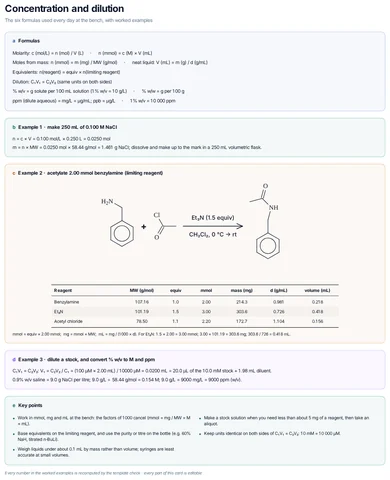
Premium template. Preview and edit it free in MolDraw; downloading and exporting it is part of MolDraw Pro.
Molarity, mmol, equivalents, C₁V₁ = C₂V₂, % w/v and ppm on one card, with three worked examples: a 0.100 M solution, an acetylation set-up in mg and mL, and a stock dilution with saline in mol/L and ppm.
What the template shows
- Concentration and dilution
- The six formulas used every day at the bench, with worked examples
- Molarity: c (mol/L) = n (mol) / V (L) · n (mmol) = c (M) × V (mL)
- Moles from mass: n (mmol) = m (mg) / MW (g/mol) · neat liquid: V (mL) = m (g) / d (g/mL)
- Equivalents: n(reagent) = equiv × n(limiting reagent)
- Dilution: C₁V₁ = C₂V₂ (same units on both sides)
- % w/v = g solute per 100 mL solution (1% w/v = 10 g/L) · % w/w = g per 100 g
- ppm (dilute aqueous) = mg/L = µg/mL; ppb = µg/L · 1% w/v = 10 000 ppm
- Example 1 · make 250 mL of 0.100 M NaCl
- n = c × V = 0.100 mol/L × 0.250 L = 0.0250 mol
- m = n × MW = 0.0250 mol × 58.44 g/mol = 1.461 g NaCl; dissolve and make up to the mark in a 250 mL volumetric flask.
- Example 2 · acetylate 2.00 mmol benzylamine (limiting reagent)
- Acetyl chloride
- mmol = equiv × 2.00 mmol; mg = mmol × MW; mL = mg / (1000 × d). For Et₃N: 1.5 × 2.00 = 3.00 mmol; 3.00 × 101.19 = 303.6 mg; 303.6 / 726 = 0.418 mL.
- Example 3 · dilute a stock, and convert % w/v to M and ppm
- C₁V₁ = C₂V₂: V₁ = C₂V₂ / C₁ = (100 µM × 2.00 mL) / 10000 µM = 0.0200 mL = 20.0 µL of the 10.0 mM stock + 1.98 mL diluent.
- 0.9% w/v saline = 9.0 g NaCl per litre; 9.0 g/L ÷ 58.44 g/mol = 0.154 M; 9.0 g/L = 9000 mg/L = 9000 ppm (w/v).
- Work in mmol, mg and mL at the bench: the factors of 1000 cancel (mmol = mg / MW = M × mL).
- Base equivalents on the limiting reagent, and use the purity or titre on the bottle (e.g. 60% NaH, titrated n-BuLi).
- Weigh liquids under about 0.1 mL by mass rather than volume; syringes are least accurate at small volumes.
- Make a stock solution when you need less than about 5 mg of a reagent, then take an aliquot.
- Keep units identical on both sides of C₁V₁ = C₂V₂: 10 mM = 10 000 µM.
- Every number in the worked examples is recomputed by the template check · every part of this card is editable
Drawn with 23 atoms, 1 arrow, 9 shapes – every one editable in MolDraw.
Sources
How to use this template
- Press Edit in MolDraw. The template opens on the canvas of the free MolDraw editor.
- Change anything: move structures, edit atoms and labels, recolour highlights or delete what you do not need.
- Add your own structures, arrows and text next to it, or combine several templates on one page.
- Export the drawing as PNG, SVG or PDF for slides, worksheets, theses and papers.
Frequently asked questions
Is the Concentration and dilution calculations template free?
You can preview the Concentration and dilution calculations template here and open and edit it in MolDraw for free. Downloading or exporting it is part of MolDraw Pro, together with the other premium templates.
Can I edit the Concentration and dilution calculations template?
Yes. It opens as an ordinary MolDraw drawing, so every structure, arrow, label and colour can be changed, and you can add your own content around it.
Is the chemistry checked?
Every structure is checked with RDKit and every curly arrow passes MolDraw’s electron-flow audit. The sources used are listed on this page.
What is on the solvent properties card?
Boiling point, density, polarity and water miscibility of the common lab solvents.