MolDraw › Templates › Biochemistry › Glucose: ring closure and glycosides
BiochemistryPremium
Glucose: ring closure and glycosides template
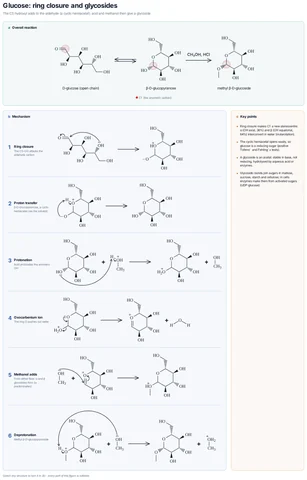
Premium template. Preview and edit it free in MolDraw; downloading and exporting it is part of MolDraw Pro.
Open-chain D-glucose closes to β-D-glucopyranose; with methanol and HCl the anomeric OH is lost as water to an oxocarbenium ion, which methanol traps to give the methyl glucopyranosides (mainly α at equilibrium; the β anomer is drawn).
Mechanism step by step
The C5 hydroxyl adds to the aldehyde (a cyclic hemiacetal); acid and methanol then give a glycoside
- Ring closure – The C5–OH attacks the aldehyde carbon
- Proton transfer – β-D-Glucopyranose, a cyclic hemiacetal (via the solvent)
- Protonation – Acid protonates the anomeric OH
- Oxocarbenium ion – The ring O pushes out water
- Methanol adds – From either face: α and β glycosides form (α predominates)
- Deprotonation – Methyl β-D-glucopyranoside
Key points
- Ring closure makes C1 a new stereocentre: α (OH axial, 36%) and β (OH equatorial, 64%) interconvert in water (mutarotation).
- The cyclic hemiacetal opens easily, so glucose is a reducing sugar (positive Tollens’ and Fehling’s tests).
- A glycoside is an acetal: stable in base, not reducing, hydrolysed by aqueous acid or enzymes.
- Glycosidic bonds join sugars in maltose, sucrose, starch and cellulose; in cells enzymes make them from activated sugars (UDP-glucose).
Drawn with 196 atoms, 20 arrows, 11 shapes – every one editable in MolDraw.
Sources
How to use this template
- Press Edit in MolDraw. The template opens on the canvas of the free MolDraw editor.
- Change anything: move structures, edit atoms and labels, recolour highlights or delete what you do not need.
- Add your own structures, arrows and text next to it, or combine several templates on one page.
- Export the drawing as PNG, SVG or PDF for slides, worksheets, theses and papers.
Frequently asked questions
Is the Glucose: ring closure and glycosides template free?
You can preview the Glucose: ring closure and glycosides template here and open and edit it in MolDraw for free. Downloading or exporting it is part of MolDraw Pro, together with the other premium templates.
Can I edit the Glucose: ring closure and glycosides template?
Yes. It opens as an ordinary MolDraw drawing, so every structure, arrow, label and colour can be changed, and you can add your own content around it.
Is the chemistry checked?
Every structure is checked with RDKit and every curly arrow passes MolDraw’s electron-flow audit. The sources used are listed on this page.
Are the biochemical pathways drawn with structures?
Yes. Pathway templates show the intermediates as structures, with enzymes and cofactors (NAD⁺, FAD, ATP) on the arrows.