MolDraw › Templates › Biochemistry › Thiamine (TPP) decarboxylation
BiochemistryPremium
Thiamine (TPP) decarboxylation template
Premium template. Preview and edit it free in MolDraw; downloading and exporting it is part of MolDraw Pro.
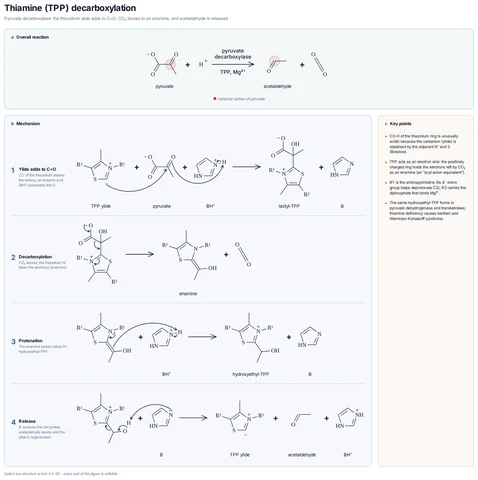
The C2 carbanion (ylide) of thiamine pyrophosphate adds to the ketone of pyruvate; the adduct loses CO₂ with the thiazolium ring as electron sink (enamine), which is protonated to hydroxyethyl-TPP and releases acetaldehyde, regenerating the ylide.
Mechanism step by step
Pyruvate decarboxylase: the thiazolium ylide adds to C=O, CO₂ leaves to an enamine, and acetaldehyde is released
- Ylide adds to C=O – C2⁻ of the thiazolium attacks the ketone; an enzyme acid (BH⁺) protonates the O
- Decarboxylation – CO₂ leaves; the thiazolium N⁺ takes the electrons (enamine)
- Protonation – The enamine carbon takes H⁺: hydroxyethyl-TPP
- Release – B removes the OH proton; acetaldehyde leaves and the ylide is regenerated
Key points
- C2–H of the thiazolium ring is unusually acidic because the carbanion (ylide) is stabilised by the adjacent N⁺ and S (Breslow).
- TPP acts as an electron sink: the positively charged ring holds the electrons left by CO₂ as an enamine (an "acyl-anion equivalent").
- R1 is the aminopyrimidine (its 4′-imino group helps deprotonate C2); R2 carries the diphosphate that binds Mg²⁺.
- The same hydroxyethyl-TPP forms in pyruvate dehydrogenase and transketolase; thiamine deficiency causes beriberi and Wernicke–Korsakoff syndrome.
Drawn with 146 atoms, 17 arrows, 8 shapes – every one editable in MolDraw.
Sources
How to use this template
- Press Edit in MolDraw. The template opens on the canvas of the free MolDraw editor.
- Change anything: move structures, edit atoms and labels, recolour highlights or delete what you do not need.
- Add your own structures, arrows and text next to it, or combine several templates on one page.
- Export the drawing as PNG, SVG or PDF for slides, worksheets, theses and papers.
Frequently asked questions
Is the Thiamine (TPP) decarboxylation template free?
You can preview the Thiamine (TPP) decarboxylation template here and open and edit it in MolDraw for free. Downloading or exporting it is part of MolDraw Pro, together with the other premium templates.
Can I edit the Thiamine (TPP) decarboxylation template?
Yes. It opens as an ordinary MolDraw drawing, so every structure, arrow, label and colour can be changed, and you can add your own content around it.
Is the chemistry checked?
Every structure is checked with RDKit and every curly arrow passes MolDraw’s electron-flow audit. The sources used are listed on this page.
Are the biochemical pathways drawn with structures?
Yes. Pathway templates show the intermediates as structures, with enzymes and cofactors (NAD⁺, FAD, ATP) on the arrows.