MolDraw › Templates › Biochemistry › PLP-dependent transamination
BiochemistryPremium
PLP-dependent transamination template
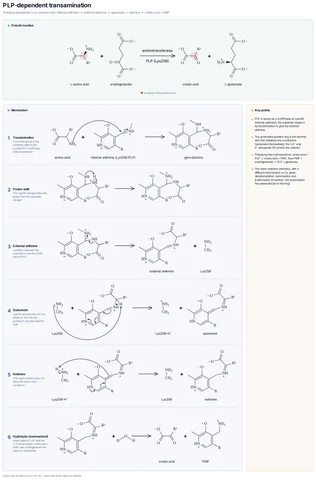
Premium template. Preview and edit it free in MolDraw; downloading and exporting it is part of MolDraw Pro.
In an aminotransferase the amino acid displaces Lys258 from PLP (transimination), Lys258 removes the α-H to give the quinonoid intermediate, reprotonation at C4′ gives the ketimine, and hydrolysis releases the α-keto acid and pyridoxamine phosphate (PMP).
Mechanism step by step
Pyridoxal phosphate is an electron sink: internal aldimine → external aldimine → quinonoid → ketimine → α-keto acid + PMP
- Transimination – The amino group of the substrate adds to the Lys258–PLP Schiff base (internal aldimine)
- Proton shift – The Lys258 nitrogen takes the proton from the substrate nitrogen
- External aldimine – Lys258 is released; the substrate is now the Schiff base of PLP
- Quinonoid – Lys258 removes the α-H; the electrons flow into the pyridinium ring (the electron sink)
- Ketimine – The ring N pushes back; C4′ takes the proton from Lys258–H⁺
- Hydrolysis (summarised) – Water adds to C=N⁺ and the C–N bond breaks: α-keto acid + PMP; with α-ketoglutarate the steps run backwards
Key points
- PLP is bound as a Schiff base to Lys258 (internal aldimine); the substrate swaps in by transimination to give the external aldimine.
- The protonated pyridine ring is the electron sink that stabilises the α-carbanion (quinonoid intermediate); the 3-O⁻ and 5′-phosphate (R) anchor the cofactor.
- Ping-pong (two half-reactions): amino acid + PLP → α-keto acid + PMP, then PMP + α-ketoglutarate → PLP + glutamate.
- The same aldimine chemistry, with a different bond broken at Cα, gives decarboxylation, racemisation and β-elimination (Dunathan: the bond broken lies perpendicular to the ring).
Drawn with 249 atoms, 22 arrows, 10 shapes – every one editable in MolDraw.
Sources
How to use this template
- Press Edit in MolDraw. The template opens on the canvas of the free MolDraw editor.
- Change anything: move structures, edit atoms and labels, recolour highlights or delete what you do not need.
- Add your own structures, arrows and text next to it, or combine several templates on one page.
- Export the drawing as PNG, SVG or PDF for slides, worksheets, theses and papers.
Frequently asked questions
Is the PLP-dependent transamination template free?
You can preview the PLP-dependent transamination template here and open and edit it in MolDraw for free. Downloading or exporting it is part of MolDraw Pro, together with the other premium templates.
Can I edit the PLP-dependent transamination template?
Yes. It opens as an ordinary MolDraw drawing, so every structure, arrow, label and colour can be changed, and you can add your own content around it.
Is the chemistry checked?
Every structure is checked with RDKit and every curly arrow passes MolDraw’s electron-flow audit. The sources used are listed on this page.
Are the biochemical pathways drawn with structures?
Yes. Pathway templates show the intermediates as structures, with enzymes and cofactors (NAD⁺, FAD, ATP) on the arrows.