MolDraw › Templates › Biochemistry › Disulfide bonds: cysteine and cystine
BiochemistryPremium
Disulfide bonds: cysteine and cystine template
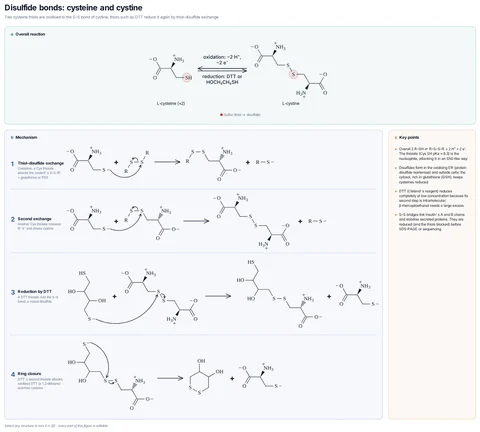
Premium template. Preview and edit it free in MolDraw; downloading and exporting it is part of MolDraw Pro.
A cysteine thiolate attacks an oxidised disulfide (in cells PDI or GSSG) and a second thiolate closes cystine. DTT reverses it: one thiolate cuts the S–S bond, the other closes DTT’s own six-membered ring.
Mechanism step by step
Two cysteine thiols are oxidised to the S–S bond of cystine; thiols such as DTT reduce it again by thiol–disulfide exchange
- Thiol–disulfide exchange – Oxidation: a Cys thiolate attacks the oxidant’s S–S (R′ = glutathione or PDI)
- Second exchange – Another Cys thiolate releases R′S⁻ and closes cystine
- Reduction by DTT – A DTT thiolate cuts the S–S bond: a mixed disulfide
- Ring closure – DTT’s second thiolate attacks: oxidised DTT (a 1,2-dithiane) and free cysteine
Key points
- Overall 2 R–SH ⇌ R–S–S–R + 2 H⁺ + 2 e⁻. The thiolate (Cys SH pKa ≈ 8.3) is the nucleophile, attacking S in an SN2-like way.
- Disulfides form in the oxidising ER (protein disulfide isomerase) and outside cells; the cytosol, rich in glutathione (GSH), keeps cysteines reduced.
- DTT (Cleland’s reagent) reduces completely at low concentration because its second step is intramolecular; β-mercaptoethanol needs a large excess.
- S–S bridges link insulin’s A and B chains and stabilise secreted proteins. They are reduced (and the thiols blocked) before SDS-PAGE or sequencing.
Drawn with 149 atoms, 13 arrows, 8 shapes – every one editable in MolDraw.
Sources
How to use this template
- Press Edit in MolDraw. The template opens on the canvas of the free MolDraw editor.
- Change anything: move structures, edit atoms and labels, recolour highlights or delete what you do not need.
- Add your own structures, arrows and text next to it, or combine several templates on one page.
- Export the drawing as PNG, SVG or PDF for slides, worksheets, theses and papers.
Frequently asked questions
Is the Disulfide bonds: cysteine and cystine template free?
You can preview the Disulfide bonds: cysteine and cystine template here and open and edit it in MolDraw for free. Downloading or exporting it is part of MolDraw Pro, together with the other premium templates.
Can I edit the Disulfide bonds: cysteine and cystine template?
Yes. It opens as an ordinary MolDraw drawing, so every structure, arrow, label and colour can be changed, and you can add your own content around it.
Is the chemistry checked?
Every structure is checked with RDKit and every curly arrow passes MolDraw’s electron-flow audit. The sources used are listed on this page.
Are the biochemical pathways drawn with structures?
Yes. Pathway templates show the intermediates as structures, with enzymes and cofactors (NAD⁺, FAD, ATP) on the arrows.