MolDraw › Templates › Catalytic cycles › Ziegler–Natta polymerisation
Catalytic cyclesPremium
Ziegler–Natta polymerisation template
Premium template. Preview and edit it free in MolDraw; downloading and exporting it is part of MolDraw Pro.
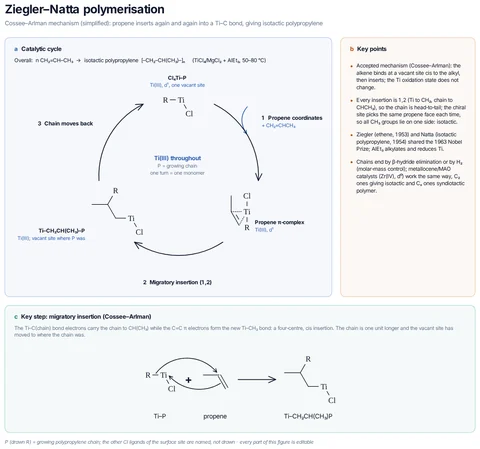
Simplified Cossee–Arlman cycle at a surface titanium site: propene coordinates at the vacant site cis to the growing chain, the chain migrates onto the alkene through a four-centre transition state (1,2-insertion), and the chain moves back so the same site geometry recurs, giving isotactic polypropylene; key step: migratory insertion with curly arrows.
What the template shows
- Cossee–Arlman mechanism (simplified): propene inserts again and again into a Ti–C bond, giving isotactic polypropylene
- Overall: n CH₂=CH–CH₃ → isotactic polypropylene [–CH₂–CH(CH₃)–]ₙ (TiCl₄/MgCl₂ + AlEt₃, 50–80 °C)
- Ti(III), d¹, one vacant site
- Propene π-complex
- Ti(III); vacant site where P was
- Ti(III) throughout
- P = growing chain
- one turn = one monomer
- Accepted mechanism (Cossee–Arlman): the alkene binds at a vacant site cis to the alkyl, then inserts; the Ti oxidation state does not change.
- Every insertion is 1,2 (Ti to CH₂, chain to CHCH₃), so the chain is head-to-tail; the chiral site picks the same propene face each time, so all CH₃ groups lie on one side: isotactic.
- Ziegler (ethene, 1953) and Natta (isotactic polypropylene, 1954) shared the 1963 Nobel Prize; AlEt₃ alkylates and reduces Ti.
- Chains end by β-hydride elimination or by H₂ (molar-mass control); metallocene/MAO catalysts (Zr(IV), d⁰) work the same way, C₂ ones giving isotactic and Cₛ ones syndiotactic polymer.
- Key step: migratory insertion (Cossee–Arlman)
- The Ti–C(chain) bond electrons carry the chain to CH(CH₃) while the C=C π electrons form the new Ti–CH₂ bond: a four-centre, cis insertion. The chain is one unit longer and the vacant site has moved to where the chain was.
- P (drawn R) = growing polypropylene chain; the other Cl ligands of the surface site are named, not drawn · every part of this figure is editable
Drawn with 27 atoms, 6 arrows, 19 shapes – every one editable in MolDraw.
Sources
How to use this template
- Press Edit in MolDraw. The template opens on the canvas of the free MolDraw editor.
- Change anything: move structures, edit atoms and labels, recolour highlights or delete what you do not need.
- Add your own structures, arrows and text next to it, or combine several templates on one page.
- Export the drawing as PNG, SVG or PDF for slides, worksheets, theses and papers.
Frequently asked questions
Is the Ziegler–Natta polymerisation template free?
You can preview the Ziegler–Natta polymerisation template here and open and edit it in MolDraw for free. Downloading or exporting it is part of MolDraw Pro, together with the other premium templates.
Can I edit the Ziegler–Natta polymerisation template?
Yes. It opens as an ordinary MolDraw drawing, so every structure, arrow, label and colour can be changed, and you can add your own content around it.
Is the chemistry checked?
Every structure is checked with RDKit and every curly arrow passes MolDraw’s electron-flow audit. The sources used are listed on this page.
What does a catalytic cycle template show?
The active catalyst, each intermediate around the cycle, the substrates that enter and the products that leave, with each elementary step named on its arrow.