MolDraw › Templates › Catalytic cycles › Suzuki–Miyaura coupling
Catalytic cyclesFree
Suzuki–Miyaura coupling template
Free template. Download it, or open it in MolDraw to change it first.
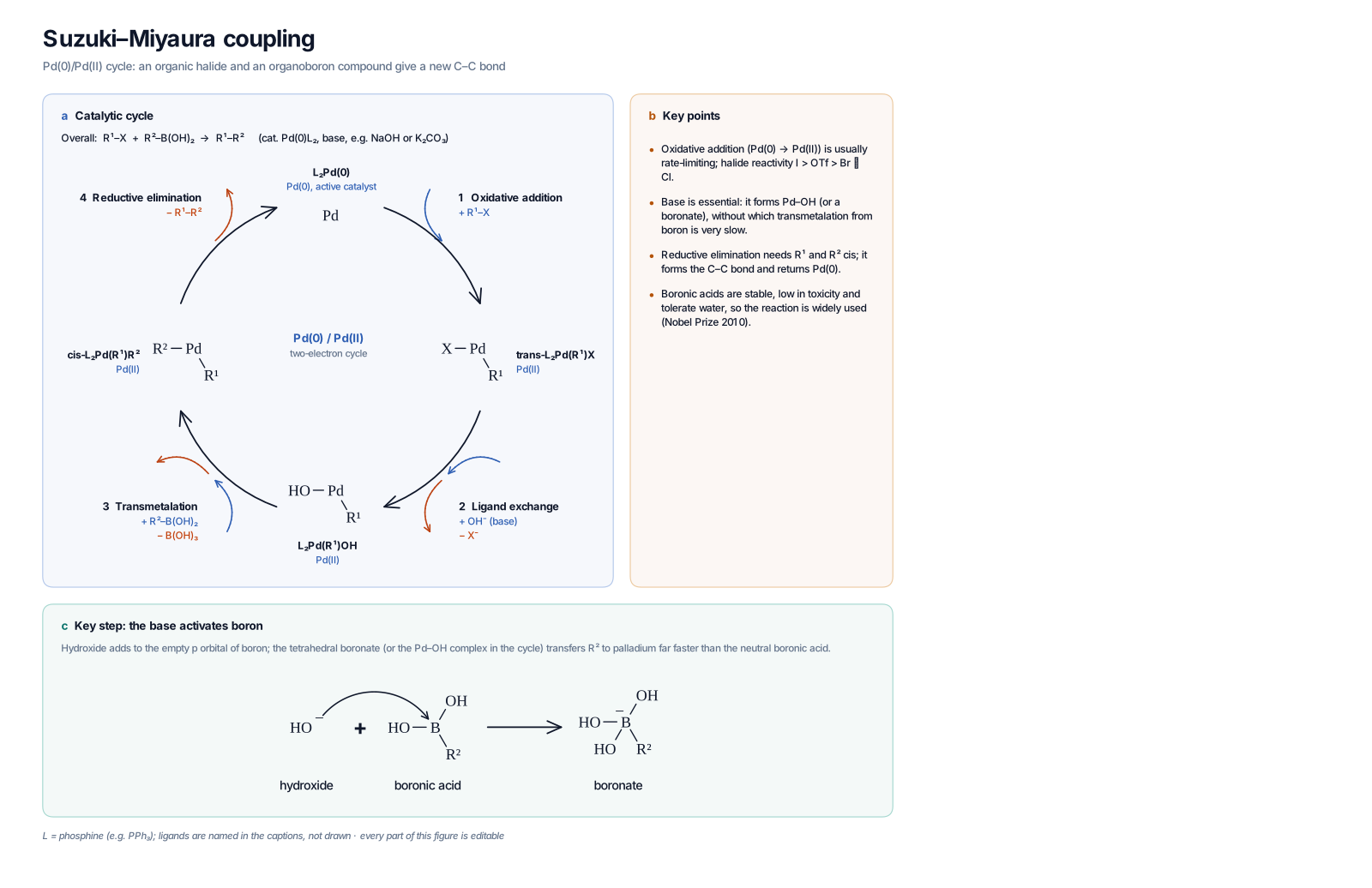
Catalytic cycle of the Suzuki–Miyaura coupling: oxidative addition of R¹–X to L₂Pd(0), exchange of X for OH (base), transmetalation from R²B(OH)₂ and reductive elimination of R¹–R²; key step: hydroxide activates the boronic acid.
What the template shows
- Pd(0)/Pd(II) cycle: an organic halide and an organoboron compound give a new C–C bond
- Overall: R¹–X + R²–B(OH)₂ → R¹–R² (cat. Pd(0)L₂, base, e.g. NaOH or K₂CO₃)
- Pd(0), active catalyst
- two-electron cycle
- Oxidative addition (Pd(0) → Pd(II)) is usually rate-limiting; halide reactivity I > OTf > Br ≫ Cl.
- Base is essential: it forms Pd–OH (or a boronate), without which transmetalation from boron is very slow.
- Reductive elimination needs R¹ and R² cis; it forms the C–C bond and returns Pd(0).
- Boronic acids are stable, low in toxicity and tolerate water, so the reaction is widely used (Nobel Prize 2010).
- Key step: the base activates boron
- Hydroxide adds to the empty p orbital of boron; the tetrahedral boronate (or the Pd–OH complex in the cycle) transfers R² to palladium far faster than the neutral boronic acid.
- boronic acid
- L = phosphine (e.g. PPh₃); ligands are named in the captions, not drawn · every part of this figure is editable
Drawn with 20 atoms, 6 arrows, 99 shapes – every one editable in MolDraw.
Sources
How to use this template
- Press Edit in MolDraw. The template opens on the canvas of the free MolDraw editor.
- Change anything: move structures, edit atoms and labels, recolour highlights or delete what you do not need.
- Add your own structures, arrows and text next to it, or combine several templates on one page.
- Export the drawing as PNG, SVG or PDF for slides, worksheets, theses and papers.
Frequently asked questions
Is the Suzuki–Miyaura coupling template free?
Yes. The Suzuki–Miyaura coupling template is one of the free MolDraw templates: open it in the editor or download it from this page as SVG or PNG and use it in your slides, worksheets and notes.
Can I edit the Suzuki–Miyaura coupling template?
Yes. It opens as an ordinary MolDraw drawing, so every structure, arrow, label and colour can be changed, and you can add your own content around it.
Is the chemistry checked?
Every structure is checked with RDKit and every curly arrow passes MolDraw’s electron-flow audit. The sources used are listed on this page.
What does a catalytic cycle template show?
The active catalyst, each intermediate around the cycle, the substrates that enter and the products that leave, with each elementary step named on its arrow.