MolDraw › Templates › Catalytic cycles › Enzyme catalytic cycle: serine protease
Catalytic cyclesPremium
Enzyme catalytic cycle: serine protease template
Premium template. Preview and edit it free in MolDraw; downloading and exporting it is part of MolDraw Pro.
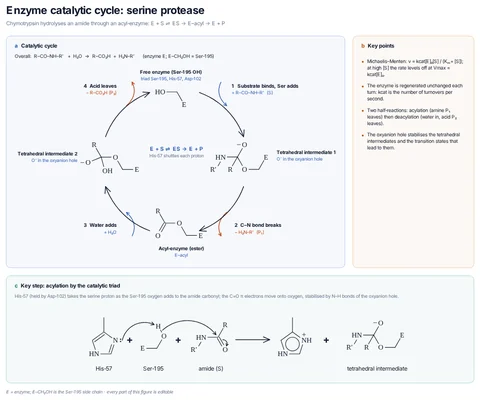
Catalytic cycle of a serine protease (chymotrypsin): Ser-195 adds to the amide C=O (tetrahedral intermediate), the amine leaves (acyl-enzyme), water adds and the acid leaves, regenerating the enzyme; Michaelis–Menten kinetics in the key points; key step: Ser–His acylation with curly arrows.
What the template shows
- Chymotrypsin hydrolyses an amide through an acyl-enzyme: E + S ⇌ ES → E–acyl → E + P
- Overall: R–CO–NH–R′ + H₂O → R–CO₂H + H₂N–R′ (enzyme E; E–CH₂OH = Ser-195)
- Free enzyme (Ser-195 OH)
- triad Ser-195, His-57, Asp-102
- Tetrahedral intermediate 1
- O⁻ in the oxyanion hole
- Acyl-enzyme (ester)
- Tetrahedral intermediate 2
- His-57 shuttles each proton
- Michaelis–Menten: v = kcat[E]₀[S] / (Kₘ + [S]); at high [S] the rate levels off at Vmax = kcat[E]₀.
- The enzyme is regenerated unchanged each turn: kcat is the number of turnovers per second.
- Two half-reactions: acylation (amine P₁ leaves) then deacylation (water in, acid P₂ leaves).
- The oxyanion hole stabilises the tetrahedral intermediates and the transition states that lead to them.
- Key step: acylation by the catalytic triad
- His-57 (held by Asp-102) takes the serine proton as the Ser-195 oxygen adds to the amide carbonyl; the C=O π electrons move onto oxygen, stabilised by N–H bonds of the oxyanion hole.
- tetrahedral intermediate
- E = enzyme; E–CH₂OH is the Ser-195 side chain · every part of this figure is editable
Drawn with 53 atoms, 8 arrows, 67 shapes – every one editable in MolDraw.
Sources
How to use this template
- Press Edit in MolDraw. The template opens on the canvas of the free MolDraw editor.
- Change anything: move structures, edit atoms and labels, recolour highlights or delete what you do not need.
- Add your own structures, arrows and text next to it, or combine several templates on one page.
- Export the drawing as PNG, SVG or PDF for slides, worksheets, theses and papers.
Frequently asked questions
Is the Enzyme catalytic cycle: serine protease template free?
You can preview the Enzyme catalytic cycle: serine protease template here and open and edit it in MolDraw for free. Downloading or exporting it is part of MolDraw Pro, together with the other premium templates.
Can I edit the Enzyme catalytic cycle: serine protease template?
Yes. It opens as an ordinary MolDraw drawing, so every structure, arrow, label and colour can be changed, and you can add your own content around it.
Is the chemistry checked?
Every structure is checked with RDKit and every curly arrow passes MolDraw’s electron-flow audit. The sources used are listed on this page.
What does a catalytic cycle template show?
The active catalyst, each intermediate around the cycle, the substrates that enter and the products that leave, with each elementary step named on its arrow.