MolDraw › Templates › Catalytic cycles › Noyori asymmetric hydrogenation
Catalytic cyclesPremium
Noyori asymmetric hydrogenation template
Premium template. Preview and edit it free in MolDraw; downloading and exporting it is part of MolDraw Pro.
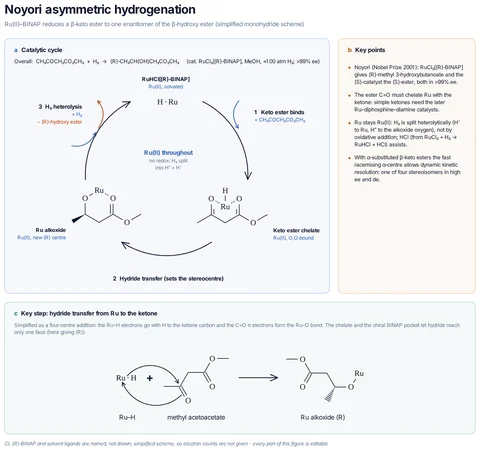
Simplified Noyori monohydride cycle for methyl acetoacetate: RuHCl[(R)-BINAP] binds the keto ester as an O,O-chelate, hydride transfer to the ketone carbon sets the stereocentre, and H₂ cleaves the Ru–O bond heterolytically to release (R)-methyl 3-hydroxybutanoate; Ru stays Ru(II); key step: hydride transfer from Ru to C=O.
What the template shows
- Ru(II)–BINAP reduces a β-keto ester to one enantiomer of the β-hydroxy ester (simplified monohydride scheme)
- Overall: CH₃COCH₂CO₂CH₃ + H₂ → (R)-CH₃CH(OH)CH₂CO₂CH₃ (cat. RuCl₂[(R)-BINAP], MeOH, ≈100 atm H₂; >99% ee)
- RuHCl[(R)-BINAP]
- Keto ester chelate
- Ru(II), new (R) centre
- no redox: H₂ split
- Noyori (Nobel Prize 2001): RuCl₂[(R)-BINAP] gives (R)-methyl 3-hydroxybutanoate and the (S)-catalyst the (S)-ester, both in >99% ee.
- The ester C=O must chelate Ru with the ketone: simple ketones need the later Ru–diphosphine–diamine catalysts.
- Ru stays Ru(II): H₂ is split heterolytically (H⁻ to Ru, H⁺ to the alkoxide oxygen), not by oxidative addition; HCl (from RuCl₂ + H₂ → RuHCl + HCl) assists.
- With α-substituted β-keto esters the fast racemising α-centre allows dynamic kinetic resolution: one of four stereoisomers in high ee and de.
- Key step: hydride transfer from Ru to the ketone
- Simplified as a four-centre addition: the Ru–H electrons go with H to the ketone carbon and the C=O π electrons form the Ru–O bond. The chelate and the chiral BINAP pocket let hydride reach only one face (here giving (R)).
- methyl acetoacetate
- Cl, (R)-BINAP and solvent ligands are named, not drawn; simplified scheme, so electron counts are not given · every part of this figure is editable
Drawn with 40 atoms, 6 arrows, 51 shapes – every one editable in MolDraw.
Sources
How to use this template
- Press Edit in MolDraw. The template opens on the canvas of the free MolDraw editor.
- Change anything: move structures, edit atoms and labels, recolour highlights or delete what you do not need.
- Add your own structures, arrows and text next to it, or combine several templates on one page.
- Export the drawing as PNG, SVG or PDF for slides, worksheets, theses and papers.
Frequently asked questions
Is the Noyori asymmetric hydrogenation template free?
You can preview the Noyori asymmetric hydrogenation template here and open and edit it in MolDraw for free. Downloading or exporting it is part of MolDraw Pro, together with the other premium templates.
Can I edit the Noyori asymmetric hydrogenation template?
Yes. It opens as an ordinary MolDraw drawing, so every structure, arrow, label and colour can be changed, and you can add your own content around it.
Is the chemistry checked?
Every structure is checked with RDKit and every curly arrow passes MolDraw’s electron-flow audit. The sources used are listed on this page.
What does a catalytic cycle template show?
The active catalyst, each intermediate around the cycle, the substrates that enter and the products that leave, with each elementary step named on its arrow.