MolDraw › Templates › Catalytic cycles › Monsanto acetic acid process
Catalytic cyclesPremium
Monsanto acetic acid process template
Premium template. Preview and edit it free in MolDraw; downloading and exporting it is part of MolDraw Pro.
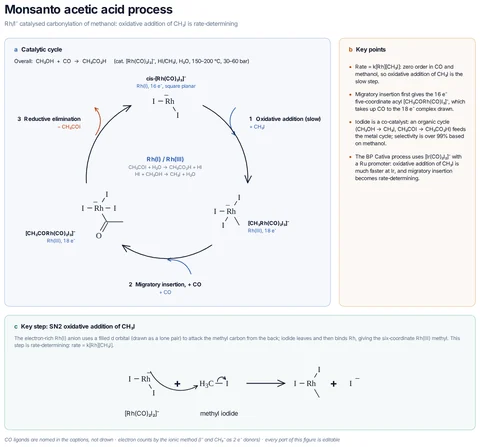
Rhodium cycle of the Monsanto process: SN2 oxidative addition of methyl iodide to cis-[Rh(CO)₂I₂]⁻ (rate-determining), methyl migration to CO with uptake of CO, and reductive elimination of acetyl iodide, which water hydrolyses to acetic acid and HI; HI turns methanol back into CH₃I; key step: SN2 attack of Rh(I) on CH₃I.
What the template shows
- Rh/I⁻ catalysed carbonylation of methanol: oxidative addition of CH₃I is rate-determining
- Overall: CH₃OH + CO → CH₃CO₂H (cat. [Rh(CO)₂I₂]⁻, HI/CH₃I, H₂O, 150–200 °C, 30–60 bar)
- Rh(I), 16 e⁻, square planar
- Rate = k[Rh][CH₃I]: zero order in CO and methanol, so oxidative addition of CH₃I is the slow step.
- Migratory insertion first gives the 16 e⁻ five-coordinate acyl [CH₃CORh(CO)I₃]⁻, which takes up CO to the 18 e⁻ complex drawn.
- Iodide is a co-catalyst: an organic cycle (CH₃OH → CH₃I, CH₃COI → CH₃CO₂H) feeds the metal cycle; selectivity is over 99% based on methanol.
- The BP Cativa process uses [Ir(CO)₂I₂]⁻ with a Ru promoter: oxidative addition of CH₃I is much faster at Ir, and migratory insertion becomes rate-determining.
- Key step: SN2 oxidative addition of CH₃I
- The electron-rich Rh(I) anion uses a filled d orbital (drawn as a lone pair) to attack the methyl carbon from the back; iodide leaves and then binds Rh, giving the six-coordinate Rh(III) methyl. This step is rate-determining: rate = k[Rh][CH₃I].
- methyl iodide
- CO ligands are named in the captions, not drawn · electron counts by the ionic method (I⁻ and CH₃⁻ as 2 e⁻ donors) · every part of this figure is editable
Drawn with 25 atoms, 6 arrows, 51 shapes – every one editable in MolDraw.
Sources
How to use this template
- Press Edit in MolDraw. The template opens on the canvas of the free MolDraw editor.
- Change anything: move structures, edit atoms and labels, recolour highlights or delete what you do not need.
- Add your own structures, arrows and text next to it, or combine several templates on one page.
- Export the drawing as PNG, SVG or PDF for slides, worksheets, theses and papers.
Frequently asked questions
Is the Monsanto acetic acid process template free?
You can preview the Monsanto acetic acid process template here and open and edit it in MolDraw for free. Downloading or exporting it is part of MolDraw Pro, together with the other premium templates.
Can I edit the Monsanto acetic acid process template?
Yes. It opens as an ordinary MolDraw drawing, so every structure, arrow, label and colour can be changed, and you can add your own content around it.
Is the chemistry checked?
Every structure is checked with RDKit and every curly arrow passes MolDraw’s electron-flow audit. The sources used are listed on this page.
What does a catalytic cycle template show?
The active catalyst, each intermediate around the cycle, the substrates that enter and the products that leave, with each elementary step named on its arrow.