MolDraw › Templates › Catalytic cycles › Kumada coupling
Catalytic cyclesPremium
Kumada coupling template
Premium template. Preview and edit it free in MolDraw; downloading and exporting it is part of MolDraw Pro.
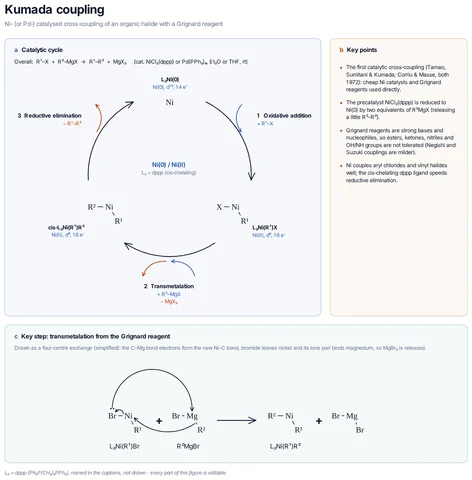
Catalytic cycle of the Kumada–Tamao–Corriu coupling with a Ni(dppp) catalyst: oxidative addition of R¹–X to Ni(0), transmetalation from R²MgX with loss of MgX₂, and reductive elimination of R¹–R²; key step: four-centre transmetalation from the Grignard reagent.
What the template shows
- Ni- (or Pd-) catalysed cross-coupling of an organic halide with a Grignard reagent
- Overall: R¹–X + R²–MgX → R¹–R² + MgX₂ (cat. NiCl₂(dppp) or Pd(PPh₃)₄, Et₂O or THF, rt)
- L₂ = dppp (cis-chelating)
- The first catalytic cross-coupling (Tamao, Sumitani & Kumada; Corriu & Masse, both 1972): cheap Ni catalysts and Grignard reagents used directly.
- The precatalyst NiCl₂(dppp) is reduced to Ni(0) by two equivalents of R²MgX (releasing a little R²–R²).
- Grignard reagents are strong bases and nucleophiles, so esters, ketones, nitriles and OH/NH groups are not tolerated (Negishi and Suzuki couplings are milder).
- Ni couples aryl chlorides and vinyl halides well; the cis-chelating dppp ligand speeds reductive elimination.
- Key step: transmetalation from the Grignard reagent
- Drawn as a four-centre exchange (simplified): the C–Mg bond electrons form the new Ni–C bond, bromide leaves nickel and its lone pair binds magnesium, so MgBr₂ is released.
- L₂ = dppp (Ph₂P(CH₂)₃PPh₂), named in the captions, not drawn · every part of this figure is editable
Drawn with 19 atoms, 7 arrows, 67 shapes – every one editable in MolDraw.
Sources
How to use this template
- Press Edit in MolDraw. The template opens on the canvas of the free MolDraw editor.
- Change anything: move structures, edit atoms and labels, recolour highlights or delete what you do not need.
- Add your own structures, arrows and text next to it, or combine several templates on one page.
- Export the drawing as PNG, SVG or PDF for slides, worksheets, theses and papers.
Frequently asked questions
Is the Kumada coupling template free?
You can preview the Kumada coupling template here and open and edit it in MolDraw for free. Downloading or exporting it is part of MolDraw Pro, together with the other premium templates.
Can I edit the Kumada coupling template?
Yes. It opens as an ordinary MolDraw drawing, so every structure, arrow, label and colour can be changed, and you can add your own content around it.
Is the chemistry checked?
Every structure is checked with RDKit and every curly arrow passes MolDraw’s electron-flow audit. The sources used are listed on this page.
What does a catalytic cycle template show?
The active catalyst, each intermediate around the cycle, the substrates that enter and the products that leave, with each elementary step named on its arrow.