MolDraw › Templates › Catalytic cycles › CuAAC click reaction
Catalytic cyclesPremium
CuAAC click reaction template
Premium template. Preview and edit it free in MolDraw; downloading and exporting it is part of MolDraw Pro.
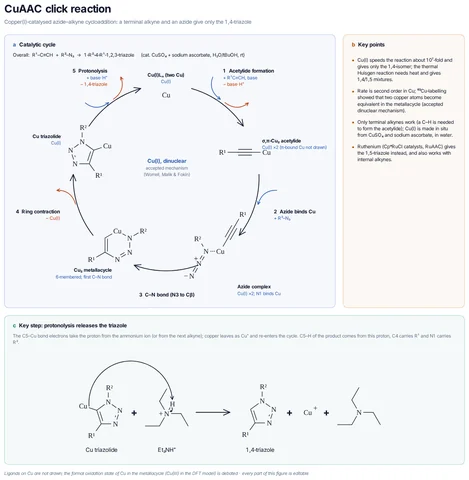
Accepted dinuclear mechanism of the Cu(I)-catalysed azide–alkyne cycloaddition (Fokin): a σ,π-bis(copper) acetylide binds the azide, the first C–N bond closes a six-membered copper metallacycle, ring contraction gives the copper triazolide and protonation releases the 1,4-disubstituted 1,2,3-triazole; key step: protonolysis of the Cu–C bond.
What the template shows
- Copper(I)-catalysed azide–alkyne cycloaddition: a terminal alkyne and an azide give only the 1,4-triazole
- Overall: R¹–C≡CH + R²–N₃ → 1-R²-4-R¹-1,2,3-triazole (cat. CuSO₄ + sodium ascorbate, H₂O/tBuOH, rt)
- Cu(I) ×2 (π-bound Cu not drawn)
- Azide complex
- 6-membered; first C–N bond
- accepted mechanism
- (Worrell, Malik & Fokin)
- Cu(I) speeds the reaction about 10⁷-fold and gives only the 1,4-isomer; the thermal Huisgen reaction needs heat and gives 1,4/1,5 mixtures.
- Rate is second order in Cu; ⁶³Cu-labelling showed that two copper atoms become equivalent in the metallacycle (accepted dinuclear mechanism).
- Only terminal alkynes work (a C–H is needed to form the acetylide); Cu(I) is made in situ from CuSO₄ and sodium ascorbate, in water.
- Ruthenium (Cp*RuCl catalysts, RuAAC) gives the 1,5-triazole instead, and also works with internal alkynes.
- Key step: protonolysis releases the triazole
- The C5–Cu bond electrons take the proton from the ammonium ion (or from the next alkyne); copper leaves as Cu⁺ and re-enters the cycle. C5–H of the product comes from this proton, C4 carries R¹ and N1 carries R².
- Ligands on Cu are not drawn; the formal oxidation state of Cu in the metallacycle (Cu(III) in the DFT model) is debated · every part of this figure is editable
Drawn with 60 atoms, 8 arrows, 99 shapes – every one editable in MolDraw.
Sources
How to use this template
- Press Edit in MolDraw. The template opens on the canvas of the free MolDraw editor.
- Change anything: move structures, edit atoms and labels, recolour highlights or delete what you do not need.
- Add your own structures, arrows and text next to it, or combine several templates on one page.
- Export the drawing as PNG, SVG or PDF for slides, worksheets, theses and papers.
Frequently asked questions
Is the CuAAC click reaction template free?
You can preview the CuAAC click reaction template here and open and edit it in MolDraw for free. Downloading or exporting it is part of MolDraw Pro, together with the other premium templates.
Can I edit the CuAAC click reaction template?
Yes. It opens as an ordinary MolDraw drawing, so every structure, arrow, label and colour can be changed, and you can add your own content around it.
Is the chemistry checked?
Every structure is checked with RDKit and every curly arrow passes MolDraw’s electron-flow audit. The sources used are listed on this page.
What does a catalytic cycle template show?
The active catalyst, each intermediate around the cycle, the substrates that enter and the products that leave, with each elementary step named on its arrow.