MolDraw › Templates › Biochemistry › Michaelis–Menten kinetics
BiochemistryPremium
Michaelis–Menten kinetics template
Premium template. Preview and edit it free in MolDraw; downloading and exporting it is part of MolDraw Pro.
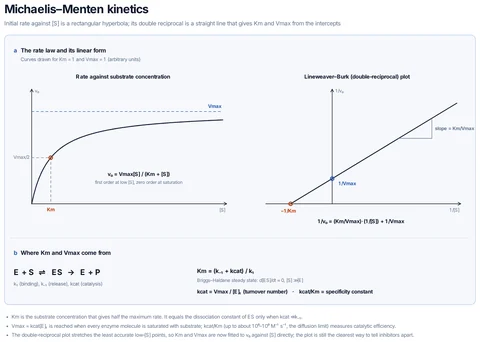
The v₀ against [S] hyperbola with Vmax and Km (the [S] at ½Vmax) marked, the Lineweaver–Burk plot (slope Km/Vmax, intercepts 1/Vmax and −1/Km), and the E + S ⇌ ES → E + P scheme with kcat and kcat/Km.
What the template shows
- Initial rate against [S] is a rectangular hyperbola; its double reciprocal is a straight line that gives Km and Vmax from the intercepts
- The rate law and its linear form
- Curves drawn for Km = 1 and Vmax = 1 (arbitrary units)
- Rate against substrate concentration
- first order at low [S], zero order at saturation
- Lineweaver–Burk (double-reciprocal) plot
- slope = Km/Vmax
- 1/v₀ = (Km/Vmax)·(1/[S]) + 1/Vmax
- Where Km and Vmax come from
- k₁ (binding), k₋₁ (release), kcat (catalysis)
- Briggs–Haldane steady state: d[ES]/dt ≈ 0, [S] ≫ [E]
- kcat = Vmax / [E]ₜ (turnover number) · kcat/Km = specificity constant
- Km is the substrate concentration that gives half the maximum rate. It equals the dissociation constant of ES only when kcat ≪ k₋₁.
- Vmax = kcat[E]ₜ is reached when every enzyme molecule is saturated with substrate; kcat/Km (up to about 10⁸–10⁹ M⁻¹ s⁻¹, the diffusion limit) measures catalytic efficiency.
- The double-reciprocal plot stretches the least accurate low-[S] points, so Km and Vmax are now fitted to v₀ against [S] directly; the plot is still the clearest way to tell inhibitors apart.
Drawn with 194 shapes – every one editable in MolDraw.
Sources
- Nelson & Cox, Lehninger Principles of Biochemistry, 8th ed., 2021, ch. 6 Textbook
- Berg, Tymoczko, Gatto & Stryer, Biochemistry, 9th ed., 2019 Textbook
- Michaelis & Menten, Biochem. Z. 1913, 49, 333; English translation: Johnson & Goody, Biochemistry 2011, 50, 8264 Original paper
- Briggs & Haldane, Biochem. J. 1925, 19, 338 Original paper
How to use this template
- Press Edit in MolDraw. The template opens on the canvas of the free MolDraw editor.
- Change anything: move structures, edit atoms and labels, recolour highlights or delete what you do not need.
- Add your own structures, arrows and text next to it, or combine several templates on one page.
- Export the drawing as PNG, SVG or PDF for slides, worksheets, theses and papers.
Frequently asked questions
Is the Michaelis–Menten kinetics template free?
You can preview the Michaelis–Menten kinetics template here and open and edit it in MolDraw for free. Downloading or exporting it is part of MolDraw Pro, together with the other premium templates.
Can I edit the Michaelis–Menten kinetics template?
Yes. It opens as an ordinary MolDraw drawing, so every structure, arrow, label and colour can be changed, and you can add your own content around it.
Is the chemistry checked?
Every structure is checked with RDKit and every curly arrow passes MolDraw’s electron-flow audit. The sources used are listed on this page.
Are the biochemical pathways drawn with structures?
Yes. Pathway templates show the intermediates as structures, with enzymes and cofactors (NAD⁺, FAD, ATP) on the arrows.