MolDraw › Templates › Biochemistry › Central dogma of molecular biology
BiochemistryPremium
Central dogma of molecular biology template
Premium template. Preview and edit it free in MolDraw; downloading and exporting it is part of MolDraw Pro.
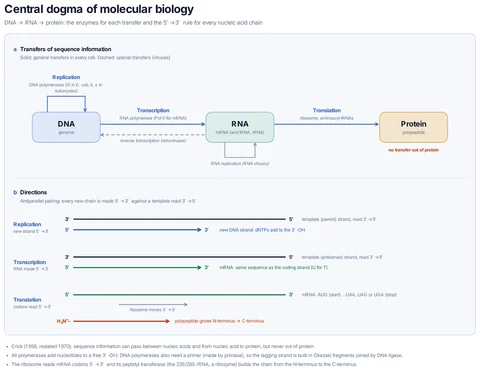
Replication, transcription and translation with their enzymes, the special transfers (reverse transcription, RNA replication), and the directions: templates read 3′→5′, new chains made 5′→3′, codons read 5′→3′ and proteins made N→C.
What the template shows
- DNA → RNA → protein: the enzymes for each transfer and the 5′→3′ rule for every nucleic acid chain
- Transfers of sequence information
- Solid: general transfers in every cell. Dashed: special transfers (viruses)
- mRNA (and tRNA, rRNA)
- DNA polymerases (III in E. coli; δ, ε in eukaryotes)
- RNA polymerase (Pol II for mRNA)
- ribosome, aminoacyl-tRNAs
- reverse transcription (retroviruses)
- RNA replication (RNA viruses)
- no transfer out of protein
- Antiparallel pairing: every new chain is made 5′→3′ against a template read 3′→5′
- new strand 5′→3′
- template (parent) strand, read 3′→5′
- new DNA strand: dNTPs add to the 3′-OH
- RNA made 5′→3′
- template (antisense) strand, read 3′→5′
- mRNA: same sequence as the coding strand (U for T)
- codons read 5′→3′
- mRNA: AUG (start) … UAA, UAG or UGA (stop)
- ribosome moves 5′→3′
- polypeptide grows N-terminus → C-terminus
- Crick (1958, restated 1970): sequence information can pass between nucleic acids and from nucleic acid to protein, but never out of protein.
- All polymerases add nucleotides to a free 3′-OH; DNA polymerases also need a primer (made by primase), so the lagging strand is built in Okazaki fragments joined by DNA ligase.
- The ribosome reads mRNA codons 5′→3′ and its peptidyl transferase (the 23S/28S rRNA, a ribozyme) builds the chain from the N-terminus to the C-terminus.
Drawn with 58 shapes – every one editable in MolDraw.
Sources
- Nelson & Cox, Lehninger Principles of Biochemistry, 8th ed., 2021, ch. 25–27 Textbook
- Berg, Tymoczko, Gatto & Stryer, Biochemistry, 9th ed., 2019 Textbook
- Crick, Symp. Soc. Exp. Biol. 1958, 12, 138 Original paper
- Crick, Nature 1970, 227, 561 Original paper
- Watson & Crick, Nature 1953, 171, 737 Original paper
How to use this template
- Press Edit in MolDraw. The template opens on the canvas of the free MolDraw editor.
- Change anything: move structures, edit atoms and labels, recolour highlights or delete what you do not need.
- Add your own structures, arrows and text next to it, or combine several templates on one page.
- Export the drawing as PNG, SVG or PDF for slides, worksheets, theses and papers.
Frequently asked questions
Is the Central dogma of molecular biology template free?
You can preview the Central dogma of molecular biology template here and open and edit it in MolDraw for free. Downloading or exporting it is part of MolDraw Pro, together with the other premium templates.
Can I edit the Central dogma of molecular biology template?
Yes. It opens as an ordinary MolDraw drawing, so every structure, arrow, label and colour can be changed, and you can add your own content around it.
Is the chemistry checked?
Every structure is checked with RDKit and every curly arrow passes MolDraw’s electron-flow audit. The sources used are listed on this page.
Are the biochemical pathways drawn with structures?
Yes. Pathway templates show the intermediates as structures, with enzymes and cofactors (NAD⁺, FAD, ATP) on the arrows.