MolDraw › Templates › Biochemistry › Amino acid zwitterions and the isoelectric point
BiochemistryPremium
Amino acid zwitterions and the isoelectric point template
Premium template. Preview and edit it free in MolDraw; downloading and exporting it is part of MolDraw Pro.
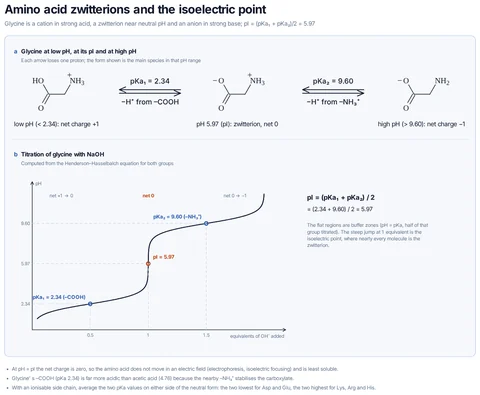
Glycine’s three forms (net +1 below pH 2.34, zwitterion at pI 5.97, net −1 above pH 9.60) and its titration curve with pKa₁ = 2.34, pKa₂ = 9.60 and pI = 5.97 marked.
What the template shows
- Glycine is a cation in strong acid, a zwitterion near neutral pH and an anion in strong base; pI = (pKa₁ + pKa₂)/2 = 5.97
- Glycine at low pH, at its pI and at high pH
- Each arrow loses one proton; the form shown is the main species in that pH range
- low pH (< 2.34): net charge +1
- pH 5.97 (pI): zwitterion, net 0
- high pH (> 9.60): net charge −1
- Titration of glycine with NaOH
- Computed from the Henderson–Hasselbalch equation for both groups
- equivalents of OH⁻ added
- pKa₁ = 2.34 (–COOH)
- pI = (pKa₁ + pKa₂) / 2
- The flat regions are buffer zones (pH = pKa, half of that group titrated). The steep jump at 1 equivalent is the isoelectric point, where nearly every molecule is the zwitterion.
- At pH = pI the net charge is zero, so the amino acid does not move in an electric field (electrophoresis, isoelectric focusing) and is least soluble.
- Glycine’s –COOH (pKa 2.34) is far more acidic than acetic acid (4.76) because the nearby –NH₃⁺ stabilises the carboxylate.
- With an ionisable side chain, average the two pKa values on either side of the neutral form: the two lowest for Asp and Glu, the two highest for Lys, Arg and His.
Drawn with 15 atoms, 2 arrows, 392 shapes – every one editable in MolDraw.
Sources
How to use this template
- Press Edit in MolDraw. The template opens on the canvas of the free MolDraw editor.
- Change anything: move structures, edit atoms and labels, recolour highlights or delete what you do not need.
- Add your own structures, arrows and text next to it, or combine several templates on one page.
- Export the drawing as PNG, SVG or PDF for slides, worksheets, theses and papers.
Frequently asked questions
Is the Amino acid zwitterions and the isoelectric point template free?
You can preview the Amino acid zwitterions and the isoelectric point template here and open and edit it in MolDraw for free. Downloading or exporting it is part of MolDraw Pro, together with the other premium templates.
Can I edit the Amino acid zwitterions and the isoelectric point template?
Yes. It opens as an ordinary MolDraw drawing, so every structure, arrow, label and colour can be changed, and you can add your own content around it.
Is the chemistry checked?
Every structure is checked with RDKit and every curly arrow passes MolDraw’s electron-flow audit. The sources used are listed on this page.
Are the biochemical pathways drawn with structures?
Yes. Pathway templates show the intermediates as structures, with enzymes and cofactors (NAD⁺, FAD, ATP) on the arrows.