MolDraw › Templates › Biochemistry › Pentose phosphate pathway: non-oxidative phase
BiochemistryPremium
Pentose phosphate pathway: non-oxidative phase template
Premium template. Preview and edit it free in MolDraw; downloading and exporting it is part of MolDraw Pro.
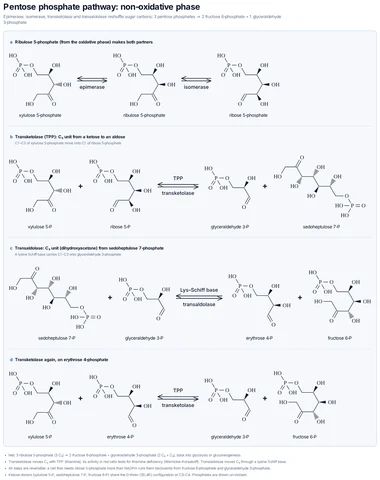
Ribulose 5-phosphate → xylulose 5-phosphate (epimerase) and ribose 5-phosphate (isomerase); transketolase (TPP, C₂ transfer) and transaldolase (C₃ transfer) give sedoheptulose 7-phosphate, erythrose 4-phosphate, fructose 6-phosphate and glyceraldehyde 3-phosphate. Open-chain structures with stereocentres.
What the template shows
- Epimerase, isomerase, transketolase and transaldolase reshuffle sugar carbons: 3 pentose phosphates → 2 fructose 6-phosphate + 1 glyceraldehyde 3-phosphate
- Ribulose 5-phosphate (from the oxidative phase) makes both partners
- xylulose 5-phosphate
- ribulose 5-phosphate
- ribose 5-phosphate
- Transketolase (TPP): C₂ unit from a ketose to an aldose
- C1–C2 of xylulose 5-phosphate move onto C1 of ribose 5-phosphate
- Transaldolase: C₃ unit (dihydroxyacetone) from sedoheptulose 7-phosphate
- A lysine Schiff base carries C1–C3 onto glyceraldehyde 3-phosphate
- Transketolase again, on erythrose 4-phosphate
- Net: 3 ribulose 5-phosphate (3 C₅) → 2 fructose 6-phosphate + glyceraldehyde 3-phosphate (2 C₆ + C₃), back into glycolysis or gluconeogenesis.
- Transketolase moves C₂ with TPP (thiamine); its activity in red cells tests for thiamine deficiency (Wernicke–Korsakoff). Transaldolase moves C₃ through a lysine Schiff base.
- All steps are reversible: a cell that needs ribose 5-phosphate more than NADPH runs them backwards from fructose 6-phosphate and glyceraldehyde 3-phosphate.
- Ketose donors (xylulose 5-P, sedoheptulose 7-P, fructose 6-P) share the D-threo (3S,4R) configuration at C3–C4. Phosphates are drawn un-ionised.
Drawn with 206 atoms, 5 arrows, 4 shapes – every one editable in MolDraw.
Sources
- Nelson & Cox, Lehninger Principles of Biochemistry, 8th ed., 2021, ch. 14 Textbook
- Berg, Tymoczko, Gatto & Stryer, Biochemistry, 9th ed., 2019 Textbook
- Voet & Voet, Biochemistry, 4th ed., Wiley 2011 Textbook
- Racker, de la Haba & Leder, Arch. Biochem. Biophys. 1954, 48, 238 Original paper
- Horecker & Smyrniotis, J. Biol. Chem. 1955, 212, 811 Original paper
How to use this template
- Press Edit in MolDraw. The template opens on the canvas of the free MolDraw editor.
- Change anything: move structures, edit atoms and labels, recolour highlights or delete what you do not need.
- Add your own structures, arrows and text next to it, or combine several templates on one page.
- Export the drawing as PNG, SVG or PDF for slides, worksheets, theses and papers.
Frequently asked questions
Is the Pentose phosphate pathway: non-oxidative phase template free?
You can preview the Pentose phosphate pathway: non-oxidative phase template here and open and edit it in MolDraw for free. Downloading or exporting it is part of MolDraw Pro, together with the other premium templates.
Can I edit the Pentose phosphate pathway: non-oxidative phase template?
Yes. It opens as an ordinary MolDraw drawing, so every structure, arrow, label and colour can be changed, and you can add your own content around it.
Is the chemistry checked?
Every structure is checked with RDKit and every curly arrow passes MolDraw’s electron-flow audit. The sources used are listed on this page.
Are the biochemical pathways drawn with structures?
Yes. Pathway templates show the intermediates as structures, with enzymes and cofactors (NAD⁺, FAD, ATP) on the arrows.