MolDraw › Templates › Biochemistry › Link reaction: pyruvate dehydrogenase
BiochemistryPremium
Link reaction: pyruvate dehydrogenase template
Premium template. Preview and edit it free in MolDraw; downloading and exporting it is part of MolDraw Pro.
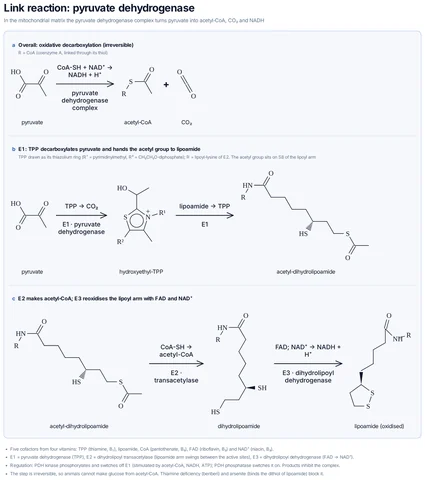
Pyruvate + CoA-SH + NAD⁺ → acetyl-CoA + CO₂ + NADH (PDH complex), with the E1/E2/E3 steps: TPP decarboxylation to hydroxyethyl-TPP, acetyl transfer to lipoamide and CoA, and reoxidation of dihydrolipoamide by FAD and NAD⁺.
What the template shows
- In the mitochondrial matrix the pyruvate dehydrogenase complex turns pyruvate into acetyl-CoA, CO₂ and NADH
- Overall: oxidative decarboxylation (irreversible)
- R = CoA (coenzyme A, linked through its thiol)
- acetyl-CoA
- E1: TPP decarboxylates pyruvate and hands the acetyl group to lipoamide
- TPP drawn as its thiazolium ring (R¹ = pyrimidinylmethyl, R² = CH₂CH₂O-diphosphate); R = lipoyl-lysine of E2. The acetyl group sits on S8 of the lipoyl arm
- hydroxyethyl-TPP
- acetyl-dihydrolipoamide
- E2 makes acetyl-CoA; E3 reoxidises the lipoyl arm with FAD and NAD⁺
- lipoamide (oxidised)
- Five cofactors from four vitamins: TPP (thiamine, B₁), lipoamide, CoA (pantothenate, B₅), FAD (riboflavin, B₂) and NAD⁺ (niacin, B₃).
- E1 = pyruvate dehydrogenase (TPP), E2 = dihydrolipoyl transacetylase (lipoamide arm swings between the active sites), E3 = dihydrolipoyl dehydrogenase (FAD → NAD⁺).
- Regulation: PDH kinase phosphorylates and switches off E1 (stimulated by acetyl-CoA, NADH, ATP); PDH phosphatase switches it on. Products inhibit the complex.
- The step is irreversible, so animals cannot make glucose from acetyl-CoA. Thiamine deficiency (beriberi) and arsenite (binds the dithiol of lipoamide) block it.
Drawn with 89 atoms, 5 arrows, 3 shapes – every one editable in MolDraw.
Sources
How to use this template
- Press Edit in MolDraw. The template opens on the canvas of the free MolDraw editor.
- Change anything: move structures, edit atoms and labels, recolour highlights or delete what you do not need.
- Add your own structures, arrows and text next to it, or combine several templates on one page.
- Export the drawing as PNG, SVG or PDF for slides, worksheets, theses and papers.
Frequently asked questions
Is the Link reaction: pyruvate dehydrogenase template free?
You can preview the Link reaction: pyruvate dehydrogenase template here and open and edit it in MolDraw for free. Downloading or exporting it is part of MolDraw Pro, together with the other premium templates.
Can I edit the Link reaction: pyruvate dehydrogenase template?
Yes. It opens as an ordinary MolDraw drawing, so every structure, arrow, label and colour can be changed, and you can add your own content around it.
Is the chemistry checked?
Every structure is checked with RDKit and every curly arrow passes MolDraw’s electron-flow audit. The sources used are listed on this page.
Are the biochemical pathways drawn with structures?
Yes. Pathway templates show the intermediates as structures, with enzymes and cofactors (NAD⁺, FAD, ATP) on the arrows.