MolDraw › Templates › Biochemistry › Heme synthesis
BiochemistryPremium
Heme synthesis template
Premium template. Preview and edit it free in MolDraw; downloading and exporting it is part of MolDraw Pro.
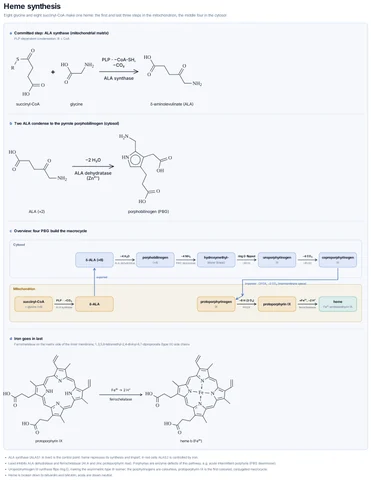
Succinyl-CoA + glycine → δ-aminolevulinate (ALA synthase, PLP); 2 ALA → porphobilinogen (ALA dehydratase); 4 PBG → hydroxymethylbilane → uroporphyrinogen III → coproporphyrinogen III → protoporphyrinogen IX → protoporphyrin IX → heme (ferrochelatase, Fe²⁺), with the compartments.
What the template shows
- Eight glycine and eight succinyl-CoA make one heme: the first and last three steps in the mitochondrion, the middle four in the cytosol
- Committed step: ALA synthase (mitochondrial matrix)
- PLP-dependent condensation; R = CoA
- succinyl-CoA
- δ-aminolevulinate (ALA)
- Two ALA condense to the pyrrole porphobilinogen (cytosol)
- porphobilinogen (PBG)
- Overview: four PBG build the macrocycle
- bilane (linear)
- ALA dehydratase
- PBG deaminase
- ring D flipped
- ALA synthase
- imported · CPOX, −2 CO₂ (intermembrane space)
- Iron goes in last
- Ferrochelatase on the matrix side of the inner membrane; 1,3,5,8-tetramethyl-2,4-divinyl-6,7-dipropionate (type IX) side chains
- ALA synthase (ALAS1 in liver) is the control point: heme represses its synthesis and import; in red cells ALAS2 is controlled by iron.
- Lead inhibits ALA dehydratase and ferrochelatase (ALA and zinc protoporphyrin rise). Porphyrias are enzyme defects of this pathway, e.g. acute intermittent porphyria (PBG deaminase).
- Uroporphyrinogen III synthase flips ring D, making the asymmetric type III isomer; the porphyrinogens are colourless, protoporphyrin IX is the first coloured, conjugated macrocycle.
- Heme is broken down to biliverdin and bilirubin; acids are drawn neutral.
Drawn with 133 atoms, 2 arrows, 51 shapes – every one editable in MolDraw.
Sources
- Nelson & Cox, Lehninger Principles of Biochemistry, 8th ed., 2021, ch. 22 Textbook
- Berg, Tymoczko, Gatto & Stryer, Biochemistry, 9th ed., 2019 Textbook
- Voet & Voet, Biochemistry, 4th ed., Wiley 2011 Textbook
- Shemin & Rittenberg, J. Biol. Chem. 1946, 166, 621 Original paper
- Shemin, Russell & Abramsky, J. Biol. Chem. 1955, 215, 613 Original paper
How to use this template
- Press Edit in MolDraw. The template opens on the canvas of the free MolDraw editor.
- Change anything: move structures, edit atoms and labels, recolour highlights or delete what you do not need.
- Add your own structures, arrows and text next to it, or combine several templates on one page.
- Export the drawing as PNG, SVG or PDF for slides, worksheets, theses and papers.
Frequently asked questions
Is the Heme synthesis template free?
You can preview the Heme synthesis template here and open and edit it in MolDraw for free. Downloading or exporting it is part of MolDraw Pro, together with the other premium templates.
Can I edit the Heme synthesis template?
Yes. It opens as an ordinary MolDraw drawing, so every structure, arrow, label and colour can be changed, and you can add your own content around it.
Is the chemistry checked?
Every structure is checked with RDKit and every curly arrow passes MolDraw’s electron-flow audit. The sources used are listed on this page.
Are the biochemical pathways drawn with structures?
Yes. Pathway templates show the intermediates as structures, with enzymes and cofactors (NAD⁺, FAD, ATP) on the arrows.