MolDraw › Templates › Biochemistry › Glycogen synthesis and breakdown
BiochemistryPremium
Glycogen synthesis and breakdown template
Premium template. Preview and edit it free in MolDraw; downloading and exporting it is part of MolDraw Pro.
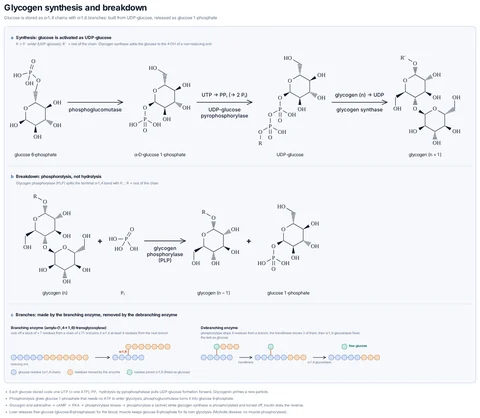
Glucose 6-phosphate → α-D-glucose 1-phosphate (phosphoglucomutase) → UDP-glucose (UTP, pyrophosphorylase) → glycogen (n + 1) (glycogen synthase), branching enzyme; glycogen phosphorylase (Pᵢ, PLP) releases glucose 1-phosphate, and the debranching enzyme removes the branches.
What the template shows
- Glucose is stored as α-1,4 chains with α-1,6 branches: built from UDP-glucose, released as glucose 1-phosphate
- Synthesis: glucose is activated as UDP-glucose
- R = 5′-uridyl (UDP-glucose); R′ = rest of the chain. Glycogen synthase adds the glucose to the 4-OH of a non-reducing end
- glucose 6-phosphate
- α-D-glucose 1-phosphate
- UDP-glucose
- Breakdown: phosphorolysis, not hydrolysis
- Glycogen phosphorylase (PLP) splits the terminal α-1,4 bond with Pᵢ; R = rest of the chain
- glucose 1-phosphate
- Branches: made by the branching enzyme, removed by the debranching enzyme
- Branching enzyme (amylo-(1,4→1,6)-transglycosylase)
- cuts off a block of ≈ 7 residues from a chain of ≥ 11 and joins it α-1,6 at least 4 residues from the next branch
- reducing end
- Debranching enzyme
- phosphorylase stops 4 residues from a branch; the transferase moves 3 of them, then α-1,6-glucosidase frees the last as glucose
- free glucose
- glucose residue (α-1,4 chain)
- residues moved by the enzyme
- residue joined α-1,6 (freed as glucose)
- Each glucose stored costs one UTP (= one ATP); PPᵢ hydrolysis by pyrophosphatase pulls UDP-glucose formation forward. Glycogenin primes a new particle.
- Phosphorolysis gives glucose 1-phosphate that needs no ATP to enter glycolysis; phosphoglucomutase turns it into glucose 6-phosphate.
- Glucagon and adrenaline → cAMP → PKA → phosphorylase kinase → phosphorylase a (active) while glycogen synthase is phosphorylated and turned off; insulin does the reverse.
- Liver releases free glucose (glucose-6-phosphatase) for the blood; muscle keeps glucose 6-phosphate for its own glycolysis (McArdle disease: no muscle phosphorylase).
Drawn with 135 atoms, 4 arrows, 111 shapes – every one editable in MolDraw.
Sources
- Nelson & Cox, Lehninger Principles of Biochemistry, 8th ed., 2021, ch. 15 Textbook
- Berg, Tymoczko, Gatto & Stryer, Biochemistry, 9th ed., 2019 Textbook
- Voet & Voet, Biochemistry, 4th ed., Wiley 2011 Textbook
- Caputto, Leloir, Cardini & Paladini, J. Biol. Chem. 1950, 184, 333 Original paper
- Leloir, Olavarría, Goldemberg & Carminatti, Arch. Biochem. Biophys. 1959, 81, 508 Original paper
- Cori, Schmidt & Cori, Science 1939, 89, 464 Original paper
How to use this template
- Press Edit in MolDraw. The template opens on the canvas of the free MolDraw editor.
- Change anything: move structures, edit atoms and labels, recolour highlights or delete what you do not need.
- Add your own structures, arrows and text next to it, or combine several templates on one page.
- Export the drawing as PNG, SVG or PDF for slides, worksheets, theses and papers.
Frequently asked questions
Is the Glycogen synthesis and breakdown template free?
You can preview the Glycogen synthesis and breakdown template here and open and edit it in MolDraw for free. Downloading or exporting it is part of MolDraw Pro, together with the other premium templates.
Can I edit the Glycogen synthesis and breakdown template?
Yes. It opens as an ordinary MolDraw drawing, so every structure, arrow, label and colour can be changed, and you can add your own content around it.
Is the chemistry checked?
Every structure is checked with RDKit and every curly arrow passes MolDraw’s electron-flow audit. The sources used are listed on this page.
Are the biochemical pathways drawn with structures?
Yes. Pathway templates show the intermediates as structures, with enzymes and cofactors (NAD⁺, FAD, ATP) on the arrows.