MolDraw › Templates › Biochemistry › Fatty acid synthesis
BiochemistryPremium
Fatty acid synthesis template
Premium template. Preview and edit it free in MolDraw; downloading and exporting it is part of MolDraw Pro.
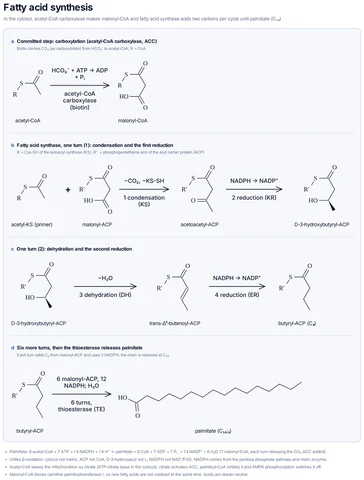
Acetyl-CoA → malonyl-CoA (acetyl-CoA carboxylase, biotin, ATP); the FAS cycle of condensation (−CO₂), reduction (NADPH), dehydration and reduction (NADPH) from acetoacetyl-ACP to butyryl-ACP, then six more cycles and the thioesterase to palmitate; stoichiometry 8 acetyl-CoA + 7 ATP + 14 NADPH.
What the template shows
- In the cytosol, acetyl-CoA carboxylase makes malonyl-CoA and fatty acid synthase adds two carbons per cycle until palmitate (C₁₆)
- Committed step: carboxylation (acetyl-CoA carboxylase, ACC)
- Biotin carries CO₂ (as carboxybiotin) from HCO₃⁻ to acetyl-CoA; R = CoA
- acetyl-CoA
- malonyl-CoA
- Fatty acid synthase, one turn (1): condensation and the first reduction
- R = Cys-SH of the ketoacyl synthase (KS), R′ = phosphopantetheine arm of the acyl carrier protein (ACP)
- acetyl-KS (primer)
- malonyl-ACP
- acetoacetyl-ACP
- D-3-hydroxybutyryl-ACP
- One turn (2): dehydration and the second reduction
- trans-Δ²-butenoyl-ACP
- butyryl-ACP (C₄)
- Six more turns, then the thioesterase releases palmitate
- Each turn adds C₂ from malonyl-ACP and uses 2 NADPH; the chain is released at C₁₆
- butyryl-ACP
- Palmitate: 8 acetyl-CoA + 7 ATP + 14 NADPH + 14 H⁺ → palmitate + 8 CoA + 7 ADP + 7 Pᵢ + 14 NADP⁺ + 6 H₂O (7 malonyl-CoA, each turn releasing the CO₂ ACC added).
- Unlike β-oxidation: cytosol not matrix, ACP not CoA, D-3-hydroxyacyl not L, NADPH not NAD⁺/FAD. NADPH comes from the pentose phosphate pathway and malic enzyme.
- Acetyl-CoA leaves the mitochondrion as citrate (ATP-citrate lyase in the cytosol); citrate activates ACC, palmitoyl-CoA inhibits it and AMPK phosphorylation switches it off.
- Malonyl-CoA blocks carnitine palmitoyltransferase I, so new fatty acids are not oxidised at the same time. Acids are drawn neutral.
Drawn with 89 atoms, 6 arrows, 4 shapes – every one editable in MolDraw.
Sources
- Nelson & Cox, Lehninger Principles of Biochemistry, 8th ed., 2021, ch. 21 Textbook
- Berg, Tymoczko, Gatto & Stryer, Biochemistry, 9th ed., 2019 Textbook
- Voet & Voet, Biochemistry, 4th ed., Wiley 2011 Textbook
- Wakil, Titchener & Gibson, Biochim. Biophys. Acta 1958, 29, 225 Original paper
- Knappe, Ringelmann & Lynen, Biochem. Z. 1961, 335, 168 Original paper
How to use this template
- Press Edit in MolDraw. The template opens on the canvas of the free MolDraw editor.
- Change anything: move structures, edit atoms and labels, recolour highlights or delete what you do not need.
- Add your own structures, arrows and text next to it, or combine several templates on one page.
- Export the drawing as PNG, SVG or PDF for slides, worksheets, theses and papers.
Frequently asked questions
Is the Fatty acid synthesis template free?
You can preview the Fatty acid synthesis template here and open and edit it in MolDraw for free. Downloading or exporting it is part of MolDraw Pro, together with the other premium templates.
Can I edit the Fatty acid synthesis template?
Yes. It opens as an ordinary MolDraw drawing, so every structure, arrow, label and colour can be changed, and you can add your own content around it.
Is the chemistry checked?
Every structure is checked with RDKit and every curly arrow passes MolDraw’s electron-flow audit. The sources used are listed on this page.
Are the biochemical pathways drawn with structures?
Yes. Pathway templates show the intermediates as structures, with enzymes and cofactors (NAD⁺, FAD, ATP) on the arrows.