MolDraw › 3D molecule models › Nitric acid structure
Nitric acid structure and 3D model (HNO3)
Nitric acid (HNO₃) is a nitrogen atom bonded to three oxygens, one of which carries the hydrogen. The molecule is flat.
Drag to rotate · pinch or scroll to zoom. 3D coordinates: computed with RDKit (ETKDG conformer, force-field optimised).
Nitric acid at a glance
| Formula | HNO3 |
|---|---|
| Molar mass | 63.01 g/mol |
| IUPAC name | nitric acid |
| Atoms / bonds | 5 / 4 |
| H-bond donors / acceptors | 1 / 2 |
| logP (estimated) | -0.3 |
| SMILES | [N+](=O)(O)[O-] |
| InChIKey | GRYLNZFGIOXLOG-UHFFFAOYSA-N |
| PubChem | 944 |
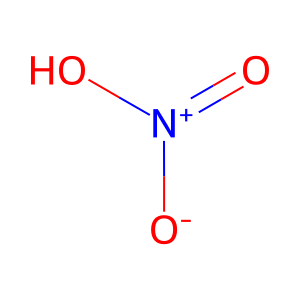
What the 3D model of Nitric acid shows
The model contains 5 atoms (4 heavy atoms and 1 hydrogens) joined by 4 bonds; in ball-and-stick mode every stick is one bond, and double or aromatic bonds are drawn as multiple sticks. Switch to space-filling to see the molecule as its electron cloud, scaled to van der Waals radii: this is the shape other molecules actually "feel". It can donate 1 and accept 2 hydrogen bonds, and its estimated logP of -0.3 means it is very water-loving (hydrophilic). Its topological polar surface area is 63 Ų.
Shape and bond angles
| Atom(s) | Geometry / hybridisation | Angles & lengths |
|---|---|---|
| nitrogen | Trigonal planar, sp² | ≈ 120° |
| O–H oxygen | Bent (two bonds, two lone pairs) | below 109.5° |
Is Nitric acid polar?
Yes, very. It is miscible with water in all proportions.
Elemental composition of HNO3
| Element | Atoms | Mass (g/mol) | Mass % |
|---|---|---|---|
| Hydrogen (H) | 1 | 1.008 | 1.60% |
| Nitrogen (N) | 1 | 14.007 | 22.23% |
| Oxygen (O) | 3 | 47.997 | 76.17% |
Calculated from IUPAC standard atomic weights. Check any formula with the molar mass calculator.
Uses of nitric acid
- Making ammonium nitrate fertiliser, its main use
- Making explosives and nylon precursors
- Etching and cleaning metals, including in semiconductor manufacture
Interesting facts
- Nitric acid is a strong acid with a pKa of −1.38.
- Pure nitric acid boils at about 83 °C.
- It is neutralised with ammonia to make ammonium nitrate.
Drawing structures for your notes? MolDraw is a free online chemical structure editor for molecules, reactions and lab diagrams.
Open MolDraw editorSources
- PubChem compound record, CID 944: structure and identifiers (pubchem.ncbi.nlm.nih.gov/compound/944)
- T. Prohaska et al., "Standard atomic weights of the elements 2021 (IUPAC Technical Report)", Pure Appl. Chem. 2022, 94, 573–600, doi:10.1515/pac-2019-0603 (molar mass and composition)
- RDKit, open-source cheminformatics (rdkit.org): formula, atom and bond counts, hydrogen-bond donors and acceptors, logP, polar surface area and the 3D conformer (ETKDG, force-field optimised)
- PubChem compound record, CID 944, sections "Solubility", "Dissociation Constants", "Boiling Point" and "Uses", which quote HSDB, NIOSH and other compiled data (pubchem.ncbi.nlm.nih.gov/compound/944) (miscible with water, pKa −1.38, boiling point 83 °C, fertiliser, explosive, nylon and etching uses)
- C. E. Housecroft, A. G. Sharpe, Inorganic Chemistry, 5th ed., Pearson, Harlow 2018 (VSEPR shapes of small inorganic molecules)
Frequently asked questions
What is the structure of Nitric acid?
Nitric acid (HNO₃) is a nitrogen atom bonded to three oxygens, one of which carries the hydrogen. The molecule is flat. Its SMILES is [N+](=O)(O)[O-].
Is nitric acid a strong acid?
Yes. With a pKa of −1.38 it is essentially fully ionised in dilute water.
What is nitric acid mainly used for?
Most of it is used to make ammonium nitrate fertiliser.
What is the chemical formula and molar mass of Nitric acid?
Nitric acid is HNO3 with a molar mass of 63.01 g/mol. It contains 5 atoms: 1 hydrogen, 1 nitrogen, 3 oxygen.
What is the IUPAC name of Nitric acid?
The IUPAC name is nitric acid.
How do I draw Nitric acid?
Open the MolDraw editor, paste the SMILES [N+](=O)(O)[O-] or type "Nitric acid" in name search, and the structure is drawn for you. You can then export it as PNG, SVG, MOL or CDXML.