MolDraw › 3D molecule models › Carbon monoxide structure
Carbon monoxide structure and 3D model (CO)
Carbon monoxide (CO) is a carbon atom triple-bonded to an oxygen atom. The molecule is linear.
Drag to rotate · pinch or scroll to zoom. 3D coordinates: computed with RDKit (ETKDG conformer, force-field optimised).
Carbon monoxide at a glance
| Formula | CO |
|---|---|
| Molar mass | 28.01 g/mol |
| IUPAC name | carbon monoxide |
| Atoms / bonds | 2 / 1 |
| H-bond donors / acceptors | 0 / 0 |
| logP (estimated) | -0.0 |
| SMILES | [C-]#[O+] |
| InChIKey | UGFAIRIUMAVXCW-UHFFFAOYSA-N |
| PubChem | 281 |
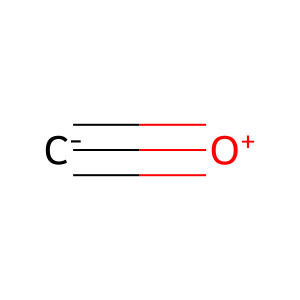
What the 3D model of Carbon monoxide shows
The model contains 2 atoms (2 heavy atoms and 0 hydrogens) joined by 1 bonds; in ball-and-stick mode every stick is one bond, and double or aromatic bonds are drawn as multiple sticks. Switch to space-filling to see the molecule as its electron cloud, scaled to van der Waals radii: this is the shape other molecules actually "feel". It can donate 0 and accept 0 hydrogen bonds, and its estimated logP of -0.0 means it is very water-loving (hydrophilic). Its topological polar surface area is 20 Ų.
Shape and bond angles
| Atom(s) | Geometry / hybridisation | Angles & lengths |
|---|---|---|
| C≡O | Linear (diatomic), triple bond | 180° |
Is Carbon monoxide polar?
Only very slightly. Water dissolves just 2.3 mL of the gas per 100 mL at 20 °C.
Elemental composition of CO
| Element | Atoms | Mass (g/mol) | Mass % |
|---|---|---|---|
| Carbon (C) | 1 | 12.011 | 42.88% |
| Oxygen (O) | 1 | 15.999 | 57.12% |
Calculated from IUPAC standard atomic weights. Check any formula with the molar mass calculator.
Uses of carbon monoxide
- Reducing agent in metallurgy and nickel refining
- Starting material for methanol, phosgene and the Fischer–Tropsch and oxo processes
- Component of gaseous fuels
Interesting facts
- It boils at about −191.5 °C.
- It forms when carbon-containing fuels burn with too little oxygen.
- Engine exhaust makes it a major air pollutant in cities.
Drawing structures for your notes? MolDraw is a free online chemical structure editor for molecules, reactions and lab diagrams.
Open MolDraw editorSources
- PubChem compound record, CID 281: structure and identifiers (pubchem.ncbi.nlm.nih.gov/compound/281)
- T. Prohaska et al., "Standard atomic weights of the elements 2021 (IUPAC Technical Report)", Pure Appl. Chem. 2022, 94, 573–600, doi:10.1515/pac-2019-0603 (molar mass and composition)
- RDKit, open-source cheminformatics (rdkit.org): formula, atom and bond counts, hydrogen-bond donors and acceptors, logP, polar surface area and the 3D conformer (ETKDG, force-field optimised)
- PubChem compound record, CID 281, sections "Solubility", "Boiling Point" and "Uses", which quote HSDB, NIOSH and other compiled data (pubchem.ncbi.nlm.nih.gov/compound/281) (solubility 2.3 mL/100 mL at 20 °C, boiling point −191.5 °C, incomplete combustion and urban pollution, industrial uses)
- C. E. Housecroft, A. G. Sharpe, Inorganic Chemistry, 5th ed., Pearson, Harlow 2018 (VSEPR shapes of small inorganic molecules)
Frequently asked questions
What is the structure of Carbon monoxide?
Carbon monoxide (CO) is a carbon atom triple-bonded to an oxygen atom. The molecule is linear. Its SMILES is [C-]#[O+].
Why is carbon monoxide formed?
When fuels burn without enough oxygen, carbon is only partly oxidised to CO instead of CO₂.
What shape is carbon monoxide?
Linear: it has only two atoms, joined by a triple bond.
What is the chemical formula and molar mass of Carbon monoxide?
Carbon monoxide is CO with a molar mass of 28.01 g/mol. It contains 2 atoms: 1 carbon, 1 oxygen.
What is the IUPAC name of Carbon monoxide?
The IUPAC name is carbon monoxide.
How do I draw Carbon monoxide?
Open the MolDraw editor, paste the SMILES [C-]#[O+] or type "Carbon monoxide" in name search, and the structure is drawn for you. You can then export it as PNG, SVG, MOL or CDXML.