How to Read an NMR Spectrum: ¹H and ¹³C Step by Step
Short answer: Read a ¹H NMR spectrum in five steps: count the signals (hydrogen environments), read each chemical shift (what the H is attached to), use the integration (how many H), the splitting (n + 1 lines for n neighbouring H) and the coupling constant J (which groups are neighbours). In a ¹³C spectrum, count the lines (one per carbon environment) and read their shift regions; use DEPT to tell CH₃, CH₂, CH and C apart.
The five things to read in a ¹H NMR spectrum
- Number of signals: how many different kinds of hydrogen (chemical environments) the molecule has. Protons related by symmetry give one signal.
- Chemical shift (δ, ppm): where a signal sits tells you what the hydrogen is attached to. Electronegative atoms, C=O groups and aromatic rings pull signals to the left (downfield).
- Integration: the area under each signal is proportional to the number of hydrogens it represents. Read it as a ratio and scale it to the molecular formula.
- Splitting (multiplicity): a signal is split by the hydrogens on neighbouring carbons. With n equivalent neighbours you see n + 1 lines (the n + 1 rule).
- Coupling constant (J, Hz): the line spacing. Two signals that split each other share the same J, which tells you which groups are next to each other.
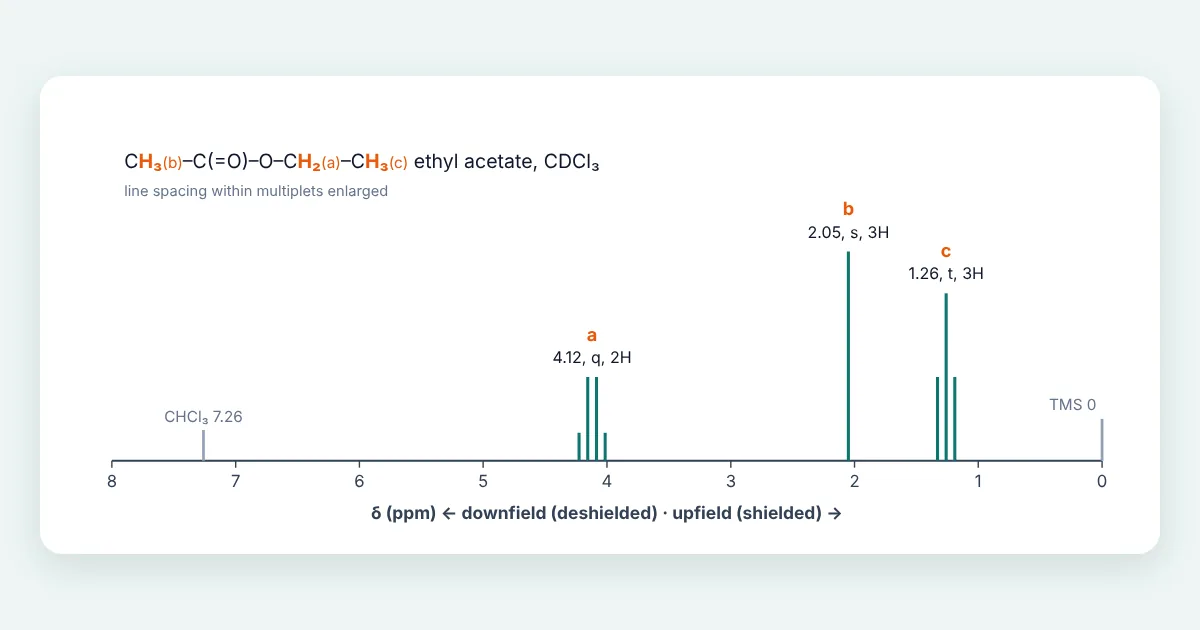
Worked example: the ¹H NMR spectrum of ethyl acetate
- Three signals, so three hydrogen environments: the acetyl CH₃ (b), the O–CH₂ (a) and the CH₃ of the ethyl group (c).
- Shifts: O–CH₂ at 4.12 ppm (on oxygen, strongly deshielded); CH₃–C=O at 2.05 ppm (next to a carbonyl); C–CH₃ at 1.26 ppm (plain alkyl).
- Integration 2 : 3 : 3 adds up to 8 H, matching C₄H₈O₂.
- Splitting: the CH₂ has three neighbours (CH₃), so it is a quartet; the ethyl CH₃ has two neighbours (CH₂), so it is a triplet; the acetyl CH₃ has no hydrogens on the next carbon, so it is a singlet.
- J: the quartet and the triplet share J ≈ 7.1 Hz, the signature of an ethyl group.
¹H chemical shifts to know
| δ (ppm) | Hydrogen type | Example |
|---|---|---|
| 0.8–1.0 | CH₃ on an alkyl chain | Hexane CH₃ 0.88 |
| 1.2–1.5 | CH₂ and CH on an alkyl chain | Cyclohexane 1.43 |
| 1.6–2.6 | Next to C=C, C=O or an aromatic ring (allylic, α to carbonyl, benzylic) | Acetone 2.17, toluene CH₃ 2.35 |
| 2.2–3.0 | Next to nitrogen (N–CH) | Triethylamine CH₂ 2.53 |
| 3.3–4.5 | On a carbon bearing O or a halogen (O–CH, Cl–CH, Br–CH) | Methanol CH₃ 3.49, ethyl acetate OCH₂ 4.12 |
| 4.5–6.5 | Alkene C=C–H | Cyclohexene 5.67 |
| 6.5–8.5 | Aromatic C–H | Benzene 7.36 |
| 9.5–10.5 | Aldehyde CHO | Benzaldehyde 10.0 |
| 10–13 | Carboxylic acid COOH (broad) | Acetic acid ~11.4 |
| 0.5–5.5 (variable) | O–H and N–H: shift depends on concentration and solvent; often broad, no splitting | Ethanol OH 1–5 |
Every value with full tables of ¹³C shifts, coupling constants and solvent peaks: NMR chemical shift table.
Splitting patterns: singlet, doublet, triplet, quartet
| Neighbouring H (n) | Pattern | Line ratio (Pascal's triangle) | Typical group |
|---|---|---|---|
| 0 | singlet (s) | 1 | CH₃–C=O, OCH₃, tert-butyl |
| 1 | doublet (d) | 1 : 1 | CH next to a single CH; (CH₃)₂CH– gives a 6H doublet |
| 2 | triplet (t) | 1 : 2 : 1 | CH₃ of an ethyl group, –CH₂–CH₂– |
| 3 | quartet (q) | 1 : 3 : 3 : 1 | CH₂ of an ethyl group |
| 4 | quintet | 1 : 4 : 6 : 4 : 1 | Middle CH₂ of –CH₂CH₂CH₂– |
| 6 | septet | 1 : 6 : 15 : 20 : 15 : 6 : 1 | CH of an isopropyl group |
| Two different sets | doublet of doublets (dd), dt … | Alkenes, substituted aromatics |
Coupling constants worth remembering
- Free-rotating alkyl chain (H–C–C–H): J ≈ 7 Hz.
- Alkene: trans 12–18 Hz, cis 6–12 Hz, geminal =CH₂ 0–3 Hz.
- Benzene ring: ortho 7–9 Hz, meta 1–3 Hz, para under 1 Hz.
- Aldehyde CHO to the neighbouring CH: 1–3 Hz.
Peaks that trip people up
- Solvent and water. In CDCl₃, residual CHCl₃ is at 7.26 ppm and water at about 1.56 ppm; in DMSO-d₆, residual DMSO is at 2.50 ppm and water at about 3.33 ppm. They are not your compound.
- O–H and N–H. They exchange, so they are often broad, have variable shifts and do not split their neighbours. Shake the sample with a drop of D₂O: the O–H/N–H signal disappears.
- Equivalent protons do not split each other. The six H of ethane give one singlet.
- Diastereotopic CH₂. Next to a stereocentre, the two H of a CH₂ are not equivalent and can show two separate signals.
- Roofing and second-order patterns. When two coupled signals are close together, the inner lines grow and the outer lines shrink, and the n + 1 rule no longer gives clean patterns.
- The degree of unsaturation. Work it out from the formula first: 4 or more with signals at 7–8 ppm suggests a benzene ring.
How to read a ¹³C NMR spectrum
- Count the lines. In a normal (proton-decoupled) ¹³C spectrum every chemically different carbon gives one line, with no splitting. Ethyl acetate has four carbons and four lines.
- Read the regions (table below). Ethyl acetate: C=O at 171.1, O–CH₂ at 60.5, CH₃–C=O at 21.0 and CH₃ at 14.2 ppm.
- Do not use peak height to count carbons. Carbons without hydrogens (C=O, quaternary C) are usually small.
- Use DEPT to tell CH₃, CH₂, CH and C apart. In DEPT-135, CH₃ and CH point up, CH₂ points down and quaternary carbons disappear; DEPT-90 shows only CH.
| δ (ppm) | Carbon type |
|---|---|
| 10–40 | sp³ alkyl carbons (CH₃, CH₂, CH) |
| 40–60 | C–N; methoxy OCH₃ 50–60 |
| 60–80 | C–O of alcohols, ethers and esters |
| 65–90 | Alkyne C≡C |
| 100–150 | Alkene C=C and aromatic carbons |
| 110–125 | Nitrile C≡N |
| 160–185 | Carboxylic acid, ester, amide C=O |
| 190–220 | Aldehyde and ketone C=O |
Putting it together: from a spectrum to a structure
- From the molecular formula, calculate the degree of unsaturation (rings + π bonds).
- Count ¹H and ¹³C signals to find the symmetry.
- Use the shifts to list the pieces: an O–CH₂, a CH₃ next to C=O, an aromatic ring, an aldehyde …
- Use integration to fix how many H each piece has, and splitting plus J to see which pieces are neighbours.
- Assemble the candidates, then check each one: does it predict the same number of signals, shifts and splittings? An IR spectrum (C=O, O–H, N–H) and the mass are quick cross-checks.
To check a candidate quickly, draw it in MolDraw and compare its predicted ¹H and ¹³C spectrum with yours using the SMILES to NMR and ¹³C NMR predictor tools, or open your own data in the NMR spectrum viewer.
Questions and answers
How do you read an H NMR spectrum?
Count the signals, read each chemical shift, use the integration to get the number of hydrogens per signal, use the splitting (n + 1 rule) to count neighbouring hydrogens, and match coupling constants to see which groups are next to each other.
What does the n + 1 rule mean?
A proton with n equivalent hydrogens on neighbouring carbons is split into n + 1 lines: no neighbours gives a singlet, one a doublet, two a triplet, three a quartet.
What do the numbers in ppm mean?
They are the chemical shift: how far a signal is from the TMS reference, relative to the spectrometer frequency. Higher ppm (left) means a more deshielded hydrogen, for example next to oxygen, a carbonyl or an aromatic ring.
How do you read a 13C NMR spectrum?
Count the lines (one per carbon environment, no splitting in a decoupled spectrum) and read their regions: 10–40 ppm alkyl, 50–80 ppm C–O, 100–150 ppm alkene and aromatic, 160–220 ppm carbonyl. Use DEPT to find CH₃, CH₂, CH and quaternary carbons.
Why is there a peak at 7.26 ppm?
It is the residual CHCl₃ in CDCl₃ solvent. In DMSO-d₆ the residual solvent peak is at 2.50 ppm and water at about 3.33 ppm.
Why does an OH peak not split?
O–H protons exchange quickly between molecules, so the coupling averages out. The signal is often broad, its position varies with concentration, and it disappears after shaking with D₂O.