Green Chemistry Metrics Explained: Atom Economy, E-Factor, PMI and Reaction Mass Efficiency
Short answer: Atom economy is the mass of the desired product divided by the total mass of the reactants in the balanced equation, times 100. E-factor is kilograms of waste per kilogram of product, and process mass intensity (PMI) is total kilograms in per kilogram of product, so PMI = E-factor + 1. Reaction mass efficiency (RME) combines yield, atom economy and excess reagents. The free green chemistry metrics calculator works all of them out from a balanced equation and your masses.
What green chemistry metrics measure
Green chemistry aims to make chemicals with less waste, less hazard and less energy. Metrics turn that aim into numbers you can compare between routes.
Atom economy is calculated from the equation before you go into the lab. Yield, RME, carbon efficiency, E-factor and PMI need real masses from an experiment or a plant.
The formulas
- Atom economy (%) = (ν × M of desired product) / (Σ ν × M of all reactants) × 100.
- Percent yield (%) = actual mass of product / theoretical mass × 100. The theoretical mass comes from the limiting reagent.
- Reaction mass efficiency (%) = mass of product / total mass of reactants used × 100. Also RME = atom economy × yield ÷ excess factor.
- Carbon efficiency (%) = moles of carbon in the product / moles of carbon in the reactants × 100.
- E-factor = (total mass in − mass of product) / mass of product. The simple E-factor leaves out solvents and water; the complete E-factor includes everything.
- Process mass intensity = total mass in / mass of product = complete E-factor + 1.
Catalysts and solvents do not appear in atom economy. They do appear in the E-factor and PMI.
How to use the green chemistry metrics calculator
- Open the green chemistry metrics calculator.
- Type the equation in Balanced equation using formulas, for example
C5H6 + C4H2O3 → C9H8O3. Press Balance equation if you only know the formulas. - Choose the Desired product. Atom economy appears at once, with molar masses from the formulas.
- Type the Mass used (g) of each reactant and the Mass of desired product isolated (g). The calculator finds the limiting reagent, theoretical yield, percent yield, RME and carbon efficiency.
- Press Add material for each solvent, water wash, reagent or catalyst, and set its Type. This gives the simple and complete E-factor and the PMI.
- Try the buttons Esterification, Diels-Alder (100% AE), Wittig reaction, Ibuprofen: Boots route and Ibuprofen: BHC route.
Worked examples
1. Esterification: atom economy 83.0%
CH₃COOH + C₂H₅OH → CH₃COOC₂H₅ + H₂O. Molar masses: 60.05 + 46.07 = 106.12 g/mol in, 88.11 g/mol of ethyl acetate out. AE = 88.11 / 106.12 × 100 = 83.0%. The other 17% leaves as water.
2. The same reaction in the lab
12.0 g acetic acid (0.200 mol, limiting) and 11.5 g ethanol (0.250 mol) give 13.2 g of ester. Theoretical yield = 0.1998 × 88.11 = 17.6 g, so the yield is 75.0%.
RME = 13.2 / 23.5 × 100 = 56.2%. Carbon efficiency = (0.150 mol × 4 C) / (0.200 × 2 + 0.250 × 2) × 100 = 66.7%.
Add 1.0 g H₂SO₄, 20 g carbonate solution and a 50 g water wash: total input 94.5 g. Complete E-factor = (94.5 − 13.2) / 13.2 = 6.16 and PMI = 7.16.
3. Diels-Alder: atom economy 100%
Cyclopentadiene + maleic anhydride → adduct: C₅H₆ + C₄H₂O₃ → C₉H₈O₃. 66.10 + 98.06 = 164.16 g/mol, which is the molar mass of the product. Every atom ends up in the product.
4. Wittig reaction: atom economy 25.7%
Ph₃P=CH₂ + cyclohexanone → methylenecyclohexane + Ph₃PO. AE = 96.17 / (276.32 + 98.14) × 100 = 25.7%. The heavy by-product triphenylphosphine oxide (278.29 g/mol) is the waste. Even at 100% yield, three quarters of the mass is lost.
5. Ibuprofen: Boots route against BHC route
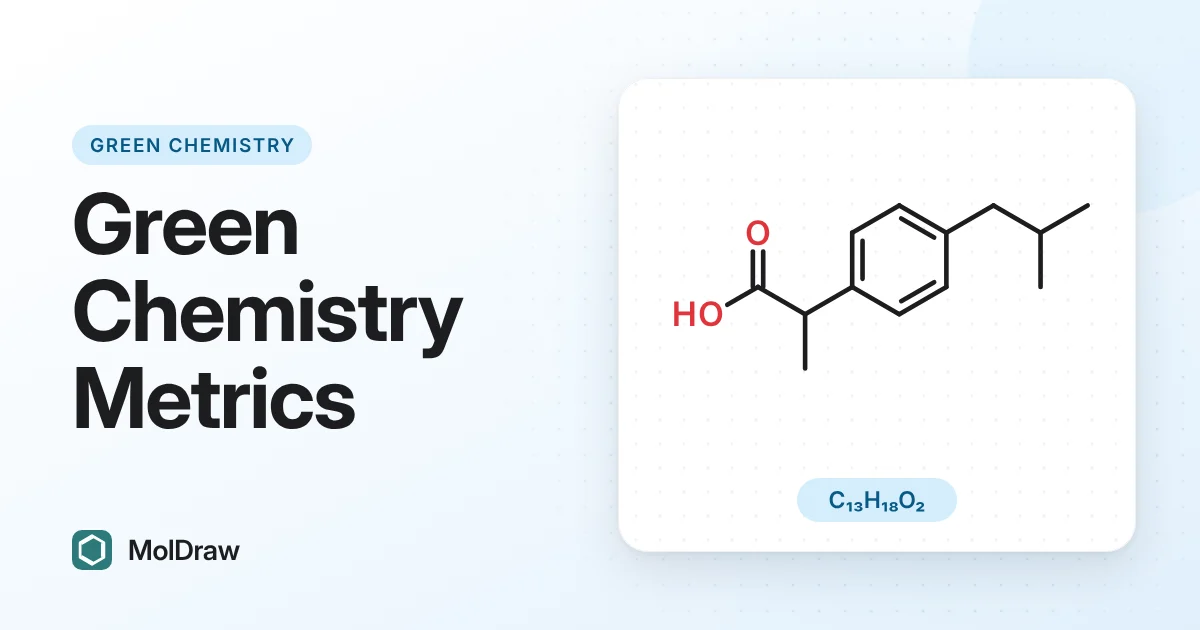
The Boots route (1960s) takes six steps. Its reagents add up to 515.0 g per 206.3 g of ibuprofen: AE = 40.1%.
The BHC route (1990s) takes three catalytic steps: C₁₀H₁₄ + C₄H₆O₃ + H₂ + CO → C₁₃H₁₈O₂ + CH₃COOH. 266.3 g in per 206.3 g out: AE = 77.5%, often quoted as 77%. When the acetic acid by-product is recovered and sold, the useful atom economy is about 99%.
Summary table
| Reaction | Type | Atom economy | By-product |
|---|---|---|---|
| Diels-Alder (C₅H₆ + C₄H₂O₃) | Addition | 100% | None |
| N₂ + 3H₂ → 2NH₃ | Addition | 100% | None |
| Esterification | Condensation | 83.0% | Water |
| Ibuprofen, BHC route | Catalytic, 3 steps | 77.5% | Acetic acid |
| Glucose → ethanol | Fermentation | 51.1% | CO₂ |
| Ibuprofen, Boots route | Stoichiometric, 6 steps | 40.1% | Salts and acids |
| Wittig methylenation | Elimination | 25.7% | Ph₃PO |
Typical complete E-factors: oil refining under 0.1, bulk chemicals under 1 to 5, fine chemicals 5 to over 50, pharmaceuticals 25 to over 100.
The 12 principles of green chemistry
- Prevent waste rather than treat it.
- Maximise atom economy.
- Use less hazardous syntheses.
- Design safer chemicals.
- Use safer solvents and auxiliaries.
- Design for energy efficiency.
- Use renewable feedstocks.
- Reduce derivatives such as protecting groups.
- Use catalysts, not stoichiometric reagents.
- Design products to degrade after use.
- Analyse in real time to prevent pollution.
- Choose inherently safer chemistry to prevent accidents.
Common mistakes
- Using an unbalanced equation, which changes the total reactant mass.
- Leaving out the coefficient of the product, for example 2NH₃.
- Treating atom economy and percent yield as the same thing.
- Putting catalysts or solvents into the atom economy denominator.
- Quoting an E-factor without saying whether solvents and water are included.
- Calculating the theoretical yield from the reagent in excess.
Exam tips
- A-level (AQA, OCR, Edexcel): atom economy questions give a balanced equation and Mr values. Show the formula, then the numbers, and give the answer to 3 significant figures.
- AP Chemistry and IB: you may be asked why a reaction with a high yield is still wasteful. Point to the by-product and the low atom economy.
- NEET and JEE: addition and rearrangement reactions have 100% atom economy; substitutions and eliminations do not.
- Remember PMI = E-factor + 1. It is a quick check on your arithmetic.
Questions and answers
How do you calculate atom economy?
Divide the formula mass of the desired product (times its coefficient) by the total formula mass of all reactants (times their coefficients) and multiply by 100. For CH3COOH + C2H5OH → CH3COOC2H5 + H2O, atom economy = 88.11 / 106.12 × 100 = 83.0%.
What is the difference between atom economy and percent yield?
Atom economy is a theoretical value from the balanced equation. Percent yield is measured and compares the product you actually got with the theoretical yield. A Wittig reaction can have a high yield but only about 26% atom economy.
What is the E-factor in green chemistry?
The E-factor is the mass of waste divided by the mass of product. Waste is everything that goes in but does not end up as product, including solvents in the complete E-factor. The ideal is 0.
What is process mass intensity?
Process mass intensity (PMI) is the total mass of all materials used, including reactants, solvents, reagents and water, divided by the mass of product. PMI = complete E-factor + 1. It is the metric most used by pharmaceutical companies.
Which reactions have 100% atom economy?
Reactions where all reactant atoms end up in one product: additions such as hydrogenation and the Diels-Alder reaction, and rearrangements. N2 + 3H2 → 2NH3 is also 100%.
Why is the BHC synthesis of ibuprofen greener than the Boots synthesis?
BHC takes three catalytic steps instead of six stoichiometric ones. Its atom economy is 77.5% compared with 40.1%, its only by-product is acetic acid, which can be recovered, and its catalysts are reused.
What is reaction mass efficiency?
RME is the mass of isolated product divided by the total mass of reactants used, times 100. It accounts for yield and for reagents used in excess, so it is always lower than or equal to the atom economy.