40 new teaching templates
In short: 17 mechanisms: resonance, carbocation rearrangement, nitration, bromination, sulfonation and Friedel–Crafts alkylation of benzene, HBr addition (Markovnikov and radical), hydration, NaBH₄, cyanohydrin, aldol condensation, Cannizzaro, Williamson, Kolbe–Schmitt, Hofmann bromamide and Reimer–Tiemann
What’s new
- 17 mechanisms: resonance, carbocation rearrangement, nitration, bromination, sulfonation and Friedel–Crafts alkylation of benzene, HBr addition (Markovnikov and radical), hydration, NaBH₄, cyanohydrin, aldol condensation, Cannizzaro, Williamson, Kolbe–Schmitt, Hofmann bromamide and Reimer–Tiemann
- Structure sets: isomerism, Lewis structures, hybridisation, the pKa ladder, directing groups, peptides, DNA base pairs with hydrogen bonds, polymers, acids and indicators, natural products and organometallic reagents
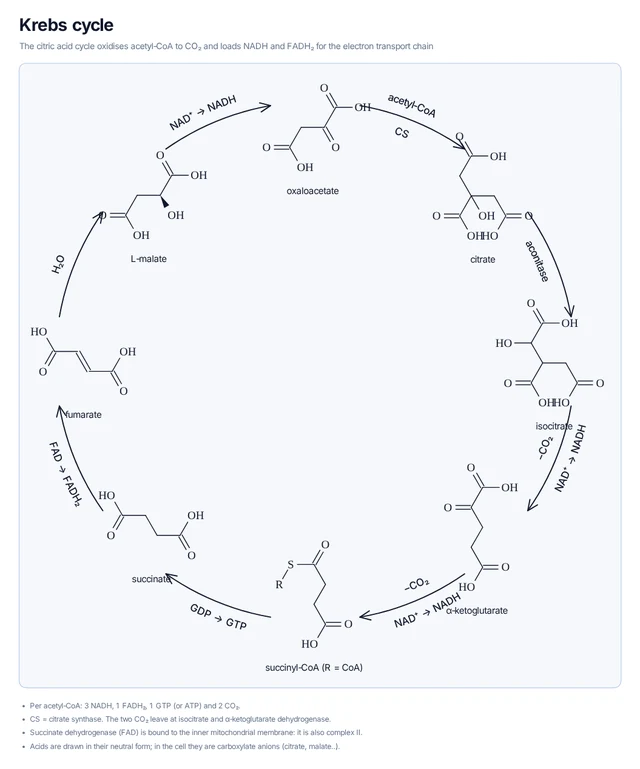
- Glycolysis and the Krebs cycle with every structure, cofactor and enzyme
- Reaction energy diagrams (SN1 vs SN2, catalysis, exo/endothermic, kinetic vs thermodynamic) and a lab colour chart (flame tests, precipitates, indicators, universal indicator)
- New reaction setups: titration, TLC, hot filtration for recrystallisation and melting point
- Explicit hydrogens now sit at 120° on C=C and straight on along C≡C; tin, lead and other elements are accepted in SMILES