MolDraw › Templates › Symmetry › Symmetry elements and operations
SymmetryFree
Symmetry elements and operations template
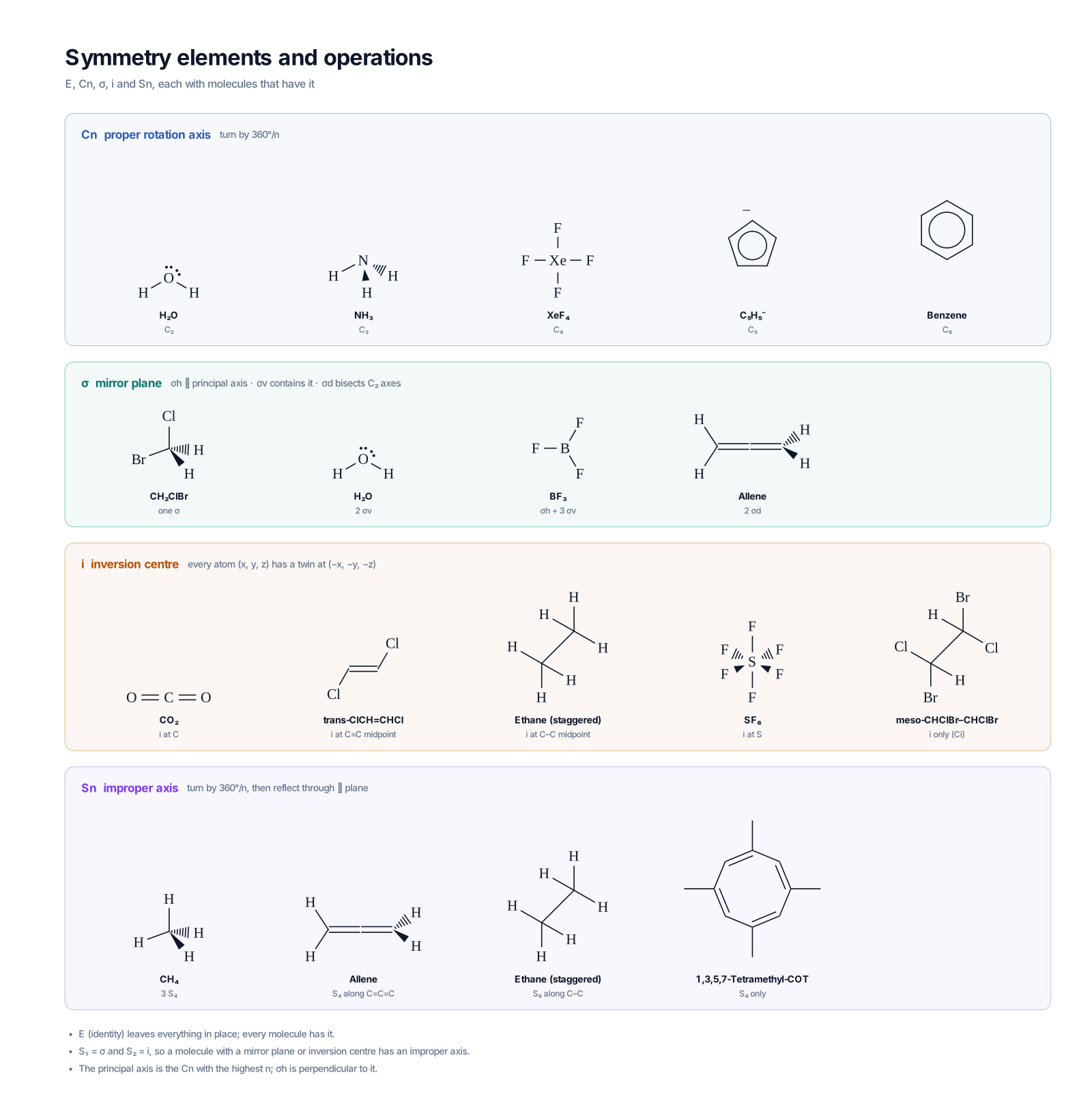
Free template. Download it, or open it in MolDraw to change it first.
The five symmetry elements: rotation axes, mirror planes, inversion centre and improper axes, with examples.
What the template shows
- E, Cn, σ, i and Sn, each with molecules that have it
- Cn proper rotation axis
- σ mirror plane
- σh ⊥ principal axis · σv contains it · σd bisects C₂ axes
- i inversion centre
- every atom (x, y, z) has a twin at (−x, −y, −z)
- trans-ClCH=CHCl
- Ethane (staggered)
- meso-CHClBr–CHClBr
- Sn improper axis
- turn by 360°/n, then reflect through ⊥ plane
- 1,3,5,7-Tetramethyl-COT
- E (identity) leaves everything in place; every molecule has it.
- S₁ = σ and S₂ = i, so a molecule with a mirror plane or inversion centre has an improper axis.
- The principal axis is the Cn with the highest n; σh is perpendicular to it.
Drawn with 104 atoms, 4 shapes – every one editable in MolDraw.
Sources
How to use this template
- Press Edit in MolDraw. The template opens on the canvas of the free MolDraw editor.
- Change anything: move structures, edit atoms and labels, recolour highlights or delete what you do not need.
- Add your own structures, arrows and text next to it, or combine several templates on one page.
- Export the drawing as PNG, SVG or PDF for slides, worksheets, theses and papers.
Frequently asked questions
Is the Symmetry elements and operations template free?
Yes. The Symmetry elements and operations template is one of the free MolDraw templates: open it in the editor or download it from this page as SVG or PNG and use it in your slides, worksheets and notes.
Can I edit the Symmetry elements and operations template?
Yes. It opens as an ordinary MolDraw drawing, so every structure, arrow, label and colour can be changed, and you can add your own content around it.
Is the chemistry checked?
Every structure is checked with RDKit and every curly arrow passes MolDraw’s electron-flow audit. The sources used are listed on this page.
Which point groups are covered?
C1, Cs, Ci, Cn, Cnv, Cnh, Dn, Dnh, Dnd, S2n, Td and Oh, each with an example molecule drawn to show its 3D shape.