MolDraw › Templates › Lab reference › Common organic reagents
Lab referenceFree
Common organic reagents template
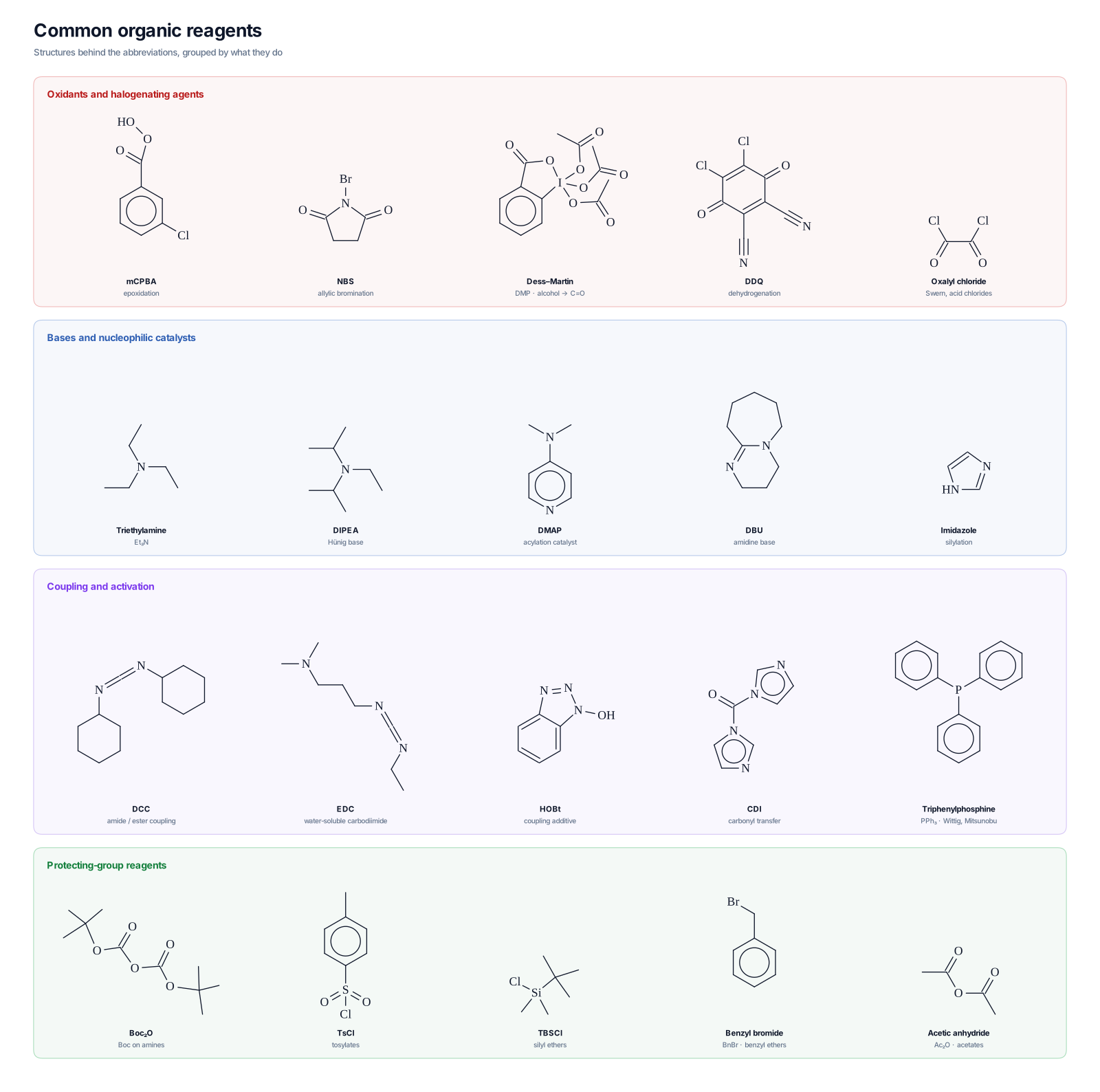
Free template. Download it, or open it in MolDraw to change it first.
Oxidants, reductants, bases, coupling and protecting-group reagents: mCPBA, NBS, DCC, Boc₂O, DMAP, DBU...
What the template shows
- Structures behind the abbreviations, grouped by what they do
- Oxidants and halogenating agents
- allylic bromination
- Dess–Martin
- DMP · alcohol → C=O
- Oxalyl chloride
- Swern, acid chlorides
- Bases and nucleophilic catalysts
- Hünig base
- acylation catalyst
- amidine base
- Coupling and activation
- amide / ester coupling
- water-soluble carbodiimide
- coupling additive
- carbonyl transfer
- PPh₃ · Wittig, Mitsunobu
- Protecting-group reagents
- Boc on amines
- silyl ethers
- Benzyl bromide
- BnBr · benzyl ethers
- Acetic anhydride
Drawn with 218 atoms, 4 shapes – every one editable in MolDraw.
Sources
How to use this template
- Press Edit in MolDraw. The template opens on the canvas of the free MolDraw editor.
- Change anything: move structures, edit atoms and labels, recolour highlights or delete what you do not need.
- Add your own structures, arrows and text next to it, or combine several templates on one page.
- Export the drawing as PNG, SVG or PDF for slides, worksheets, theses and papers.
Frequently asked questions
Is the Common organic reagents template free?
Yes. The Common organic reagents template is one of the free MolDraw templates: open it in the editor or download it from this page as SVG or PNG and use it in your slides, worksheets and notes.
Can I edit the Common organic reagents template?
Yes. It opens as an ordinary MolDraw drawing, so every structure, arrow, label and colour can be changed, and you can add your own content around it.
Is the chemistry checked?
Every structure is checked with RDKit and every curly arrow passes MolDraw’s electron-flow audit. The sources used are listed on this page.
What is on the lab colour chart?
The colours of common precipitates, flame tests and indicators, as used in qualitative analysis.