MolDraw › Templates › Materials › Polymers
MaterialsFree
Polymers template
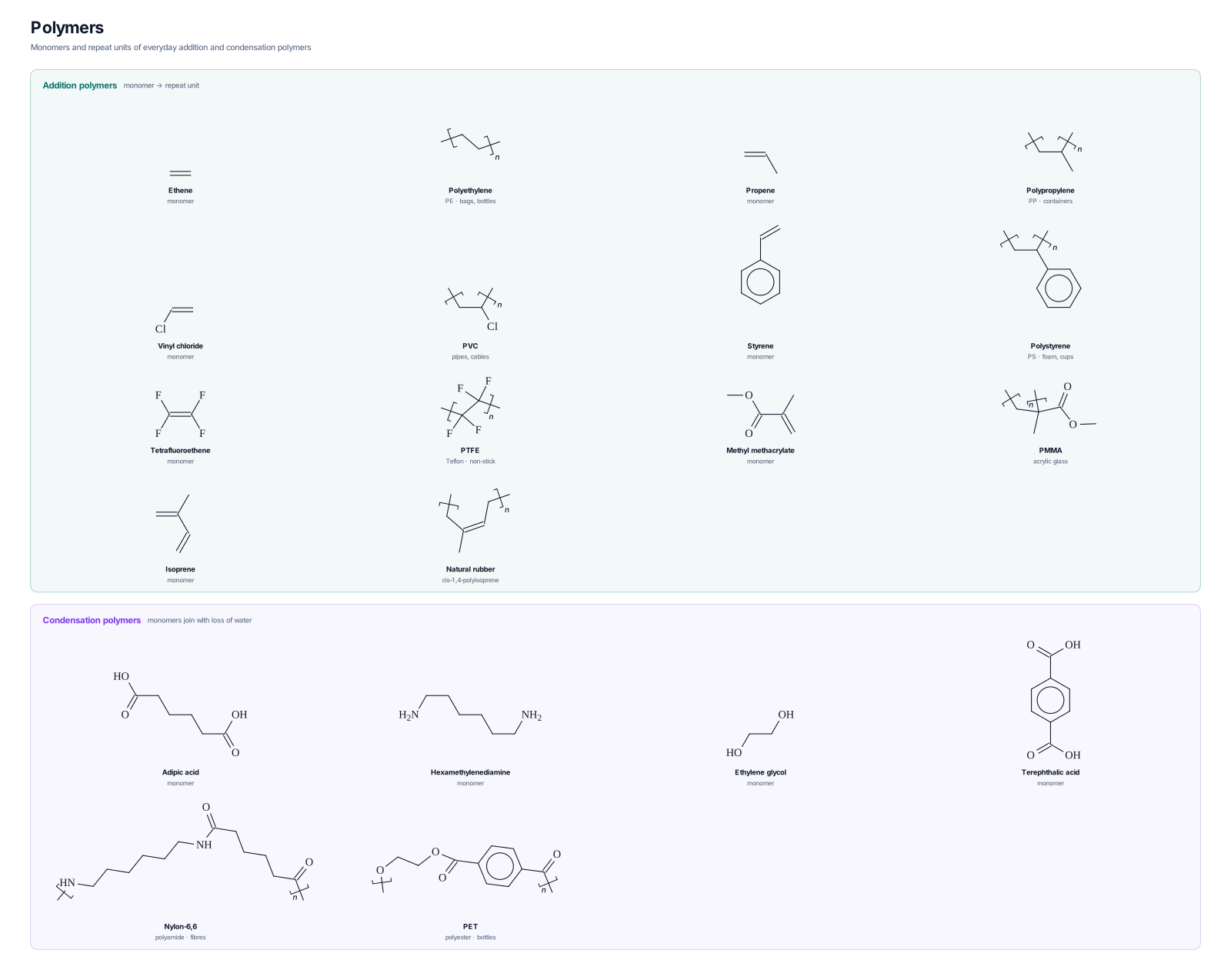
Free template. Download it, or open it in MolDraw to change it first.
Polyethylene, polypropylene, PVC, polystyrene, PTFE, PMMA, natural rubber, nylon-6,6 and PET: monomers and bracketed repeat units.
What the template shows
- Monomers and repeat units of everyday addition and condensation polymers
- Addition polymers
- monomer → repeat unit
- PE · bags, bottles
- Vinyl chloride
- pipes, cables
- PS · foam, cups
- Teflon · non-stick
- Methyl methacrylate
- acrylic glass
- Natural rubber
- cis-1,4-polyisoprene
- Condensation polymers
- monomers join with loss of water
- Adipic acid
- Ethylene glycol
- Terephthalic acid
- polyamide · fibres
- polyester · bottles
Drawn with 150 atoms, 56 shapes – every one editable in MolDraw.
Sources
How to use this template
- Press Edit in MolDraw. The template opens on the canvas of the free MolDraw editor.
- Change anything: move structures, edit atoms and labels, recolour highlights or delete what you do not need.
- Add your own structures, arrows and text next to it, or combine several templates on one page.
- Export the drawing as PNG, SVG or PDF for slides, worksheets, theses and papers.
Frequently asked questions
Is the Polymers template free?
Yes. The Polymers template is one of the free MolDraw templates: open it in the editor or download it from this page as SVG or PNG and use it in your slides, worksheets and notes.
Can I edit the Polymers template?
Yes. It opens as an ordinary MolDraw drawing, so every structure, arrow, label and colour can be changed, and you can add your own content around it.
Is the chemistry checked?
Every structure is checked with RDKit and every curly arrow passes MolDraw’s electron-flow audit. The sources used are listed on this page.
Are repeat units shown?
Yes, each polymer is drawn as a bracketed repeat unit with n.