MolDraw › Templates › General chemistry › Acids, bases and indicators
Acids, bases and indicators template
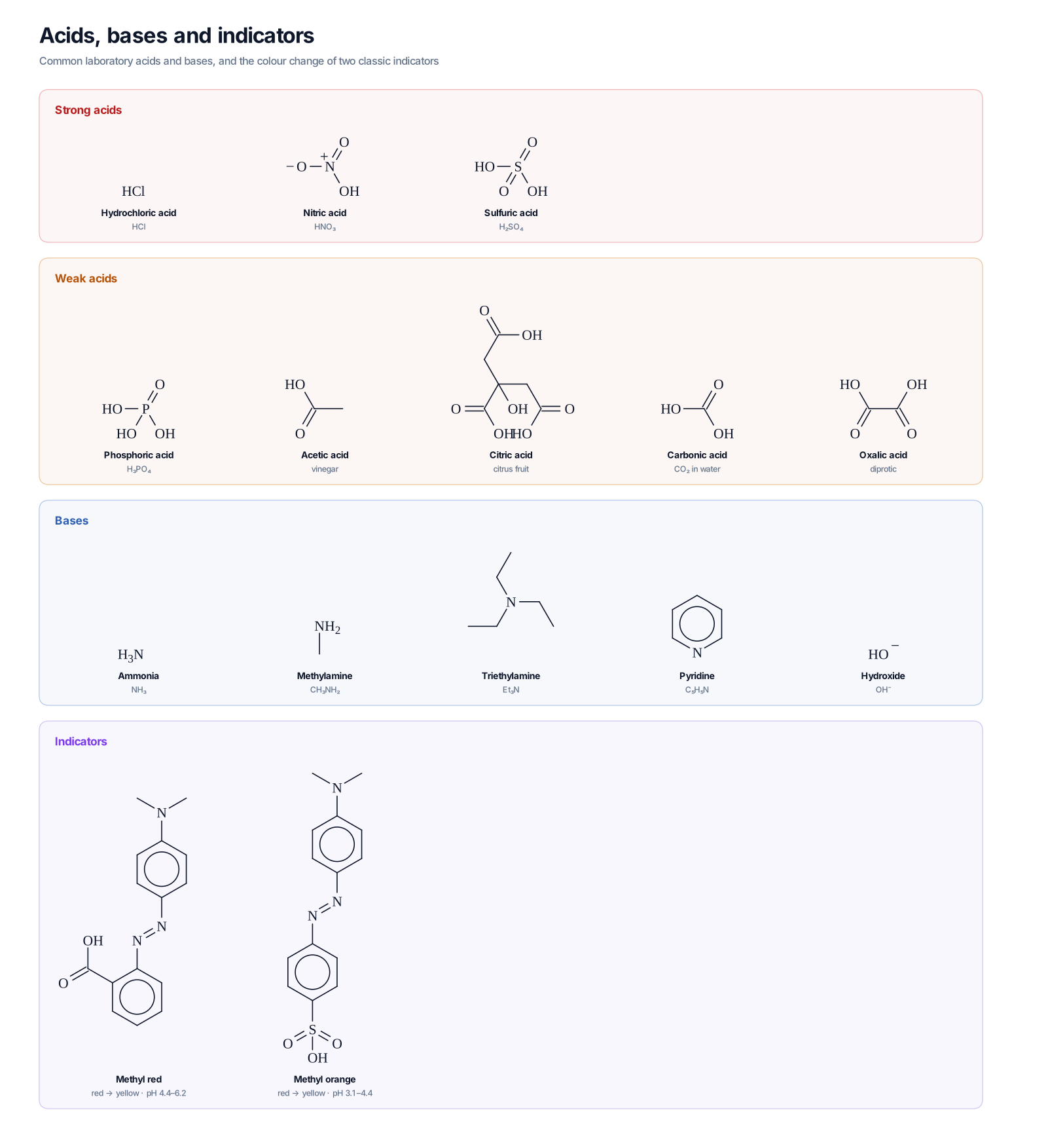
Free template. Download it, or open it in MolDraw to change it first.
HCl, HNO₃, H₂SO₄, H₃PO₄, acetic, citric and carbonic acids, ammonia and amines, methyl orange and methyl red.
What the template shows
- Common laboratory acids and bases, and the colour change of two classic indicators
- Strong acids
- Hydrochloric acid
- Nitric acid
- Sulfuric acid
- Weak acids
- Phosphoric acid
- Acetic acid
- Citric acid
- citrus fruit
- Carbonic acid
- Oxalic acid
- Methyl red
- red → yellow · pH 4.4–6.2
- Methyl orange
- red → yellow · pH 3.1–4.4
Drawn with 100 atoms, 4 shapes – every one editable in MolDraw.
Sources
How to use this template
- Press Edit in MolDraw. The template opens on the canvas of the free MolDraw editor.
- Change anything: move structures, edit atoms and labels, recolour highlights or delete what you do not need.
- Add your own structures, arrows and text next to it, or combine several templates on one page.
- Export the drawing as PNG, SVG or PDF for slides, worksheets, theses and papers.
Frequently asked questions
Is the Acids, bases and indicators template free?
Yes. The Acids, bases and indicators template is one of the free MolDraw templates: open it in the editor or download it from this page as SVG or PNG and use it in your slides, worksheets and notes.
Can I edit the Acids, bases and indicators template?
Yes. It opens as an ordinary MolDraw drawing, so every structure, arrow, label and colour can be changed, and you can add your own content around it.
Is the chemistry checked?
Every structure is checked with RDKit and every curly arrow passes MolDraw’s electron-flow audit. The sources used are listed on this page.
Do the Lewis structures show lone pairs?
Yes. Every lone pair and formal charge is drawn, as most syllabuses expect.