MolDraw › 3D molecule models › Pyridine structure
Pyridine structure and 3D model (C5H5N)
Pyridine is a benzene-like ring in which one CH is replaced by a nitrogen atom. The ring is flat and aromatic.
Drag to rotate · pinch or scroll to zoom. 3D coordinates: computed with RDKit (ETKDG conformer, force-field optimised).
Pyridine at a glance
| Formula | C5H5N |
|---|---|
| Molar mass | 79.10 g/mol |
| IUPAC name | pyridine |
| Atoms / bonds | 11 / 11 |
| H-bond donors / acceptors | 0 / 1 |
| logP (estimated) | 1.1 |
| SMILES | C1=CC=NC=C1 |
| InChIKey | JUJWROOIHBZHMG-UHFFFAOYSA-N |
| PubChem | 1049 |
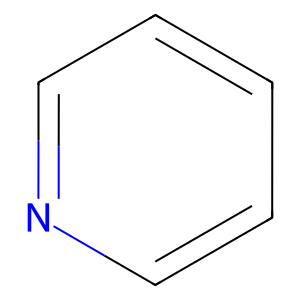
What the 3D model of Pyridine shows
The model contains 11 atoms (6 heavy atoms and 5 hydrogens) joined by 11 bonds; in ball-and-stick mode every stick is one bond, and double or aromatic bonds are drawn as multiple sticks. Switch to space-filling to see the molecule as its electron cloud, scaled to van der Waals radii: this is the shape other molecules actually "feel". It can donate 0 and accept 1 hydrogen bonds, and its estimated logP of 1.1 means it is fairly balanced between water and fat. Its topological polar surface area is 13 Ų.
Shape and bond angles
| Atom(s) | Geometry / hybridisation | Angles & lengths |
|---|---|---|
| ring atoms | Trigonal planar, sp²; planar ring | ≈ 120° |
| nitrogen lone pair | In the ring plane, not part of the aromatic π system | – |
Is Pyridine polar?
Yes. The nitrogen makes it polar and it accepts hydrogen bonds; it is miscible with water at 20 °C.
Elemental composition of C5H5N
| Element | Atoms | Mass (g/mol) | Mass % |
|---|---|---|---|
| Carbon (C) | 5 | 60.055 | 75.92% |
| Hydrogen (H) | 5 | 5.040 | 6.37% |
| Nitrogen (N) | 1 | 14.007 | 17.71% |
Calculated from IUPAC standard atomic weights. Check any formula with the molar mass calculator.
Uses of pyridine
- Intermediate for the herbicides paraquat and diquat
- Used to make vitamins (especially nicotinic acid) and sulfa drugs
- Solvent in organic synthesis and drug manufacture
Interesting facts
- Pyridine is a weak base: its conjugate acid, the pyridinium ion, has a pKa of 5.23.
- It boils at about 115 °C.
- Its nitrogen lone pair lies in the ring plane, so protonating it does not destroy the aromatic sextet.
Drawing structures for your notes? MolDraw is a free online chemical structure editor for molecules, reactions and lab diagrams.
Open MolDraw editorSources
- PubChem compound record, CID 1049: structure and identifiers (pubchem.ncbi.nlm.nih.gov/compound/1049)
- T. Prohaska et al., "Standard atomic weights of the elements 2021 (IUPAC Technical Report)", Pure Appl. Chem. 2022, 94, 573–600, doi:10.1515/pac-2019-0603 (molar mass and composition)
- RDKit, open-source cheminformatics (rdkit.org): formula, atom and bond counts, hydrogen-bond donors and acceptors, logP, polar surface area and the 3D conformer (ETKDG, force-field optimised)
- PubChem compound record, CID 1049, sections "Solubility", "Dissociation Constants", "Boiling Point" and "Uses", which quote HSDB, NIOSH and other compiled data (pubchem.ncbi.nlm.nih.gov/compound/1049) (miscible with water at 20 °C, pKa 5.23, boiling point 115.2 °C, herbicide, vitamin, drug and solvent uses)
- J. Clayden, N. Greeves, S. Warren, Organic Chemistry, 2nd ed., Oxford University Press, Oxford 2012 (bond geometry, resonance and hydrogen bonding)
Functional groups and IR spectrum of Pyridine
Functional groups: Heteroaromatic ring.
Key IR bands (predicted, solid or neat liquid)
| Wavenumber (cm⁻¹) | Range | Intensity | Assignment |
|---|---|---|---|
| 1590 | 1560–1610 | medium | Ring stretch (heteroaromatic) |
Typical positions from MolDraw's IR prediction rules (beta), not a measured spectrum. Look up any peak in the IR spectroscopy chart or predict the full spectrum with the IR spectrum predictor.
Exact mass for mass spectrometry
Monoisotopic (exact) mass of C5H5N: 79.0422 u; [M+H]⁺ m/z 80.0495; [M+Na]⁺ m/z 102.0314. Average molar mass: 79.10 g/mol. See the exact mass calculator.
Frequently asked questions
What is the structure of Pyridine?
Pyridine is a benzene-like ring in which one CH is replaced by a nitrogen atom. The ring is flat and aromatic. Its SMILES is C1=CC=NC=C1.
Is pyridine aromatic?
Yes. It has six π electrons in a planar ring, like benzene.
Why is pyridine basic?
The nitrogen lone pair is not part of the aromatic ring, so it is free to accept a proton.
What is the chemical formula and molar mass of Pyridine?
Pyridine is C5H5N with a molar mass of 79.10 g/mol. It contains 11 atoms: 5 carbon, 5 hydrogen, 1 nitrogen.
What is the IUPAC name of Pyridine?
The IUPAC name is pyridine.
How do I draw Pyridine?
Open the MolDraw editor, paste the SMILES C1=CC=NC=C1 or type "Pyridine" in name search, and the structure is drawn for you. You can then export it as PNG, SVG, MOL or CDXML.