MolDraw › 3D molecule models › Cyclohexane structure
Cyclohexane structure and 3D model (C6H12)
Cyclohexane is a ring of six CH₂ groups. Its most stable shape is the chair conformation.
Drag to rotate · pinch or scroll to zoom. 3D coordinates: computed with RDKit (ETKDG conformer, force-field optimised).
Cyclohexane at a glance
| Formula | C6H12 |
|---|---|
| Molar mass | 84.16 g/mol |
| IUPAC name | cyclohexane |
| Atoms / bonds | 18 / 18 |
| H-bond donors / acceptors | 0 / 0 |
| logP (estimated) | 2.3 |
| SMILES | C1CCCCC1 |
| InChIKey | XDTMQSROBMDMFD-UHFFFAOYSA-N |
| PubChem | 8078 |
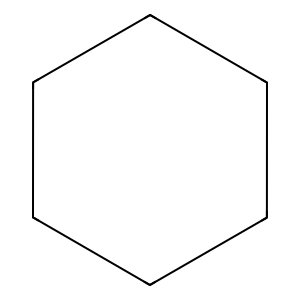
What the 3D model of Cyclohexane shows
The model contains 18 atoms (6 heavy atoms and 12 hydrogens) joined by 18 bonds; in ball-and-stick mode every stick is one bond, and double or aromatic bonds are drawn as multiple sticks. Switch to space-filling to see the molecule as its electron cloud, scaled to van der Waals radii: this is the shape other molecules actually "feel". It can donate 0 and accept 0 hydrogen bonds, and its estimated logP of 2.3 means it is fat-loving (lipophilic). Its topological polar surface area is 0 Ų.
Shape and bond angles
| Atom(s) | Geometry / hybridisation | Angles & lengths |
|---|---|---|
| ring carbons | Tetrahedral, sp³; chair | ≈ 111° (C–C–C) |
Is Cyclohexane polar?
No. It is a non-polar hydrocarbon; water dissolves only 55 mg/L at 25 °C.
Elemental composition of C6H12
| Element | Atoms | Mass (g/mol) | Mass % |
|---|---|---|---|
| Carbon (C) | 6 | 72.066 | 85.63% |
| Hydrogen (H) | 12 | 12.096 | 14.37% |
Calculated from IUPAC standard atomic weights. Check any formula with the molar mass calculator.
Uses of cyclohexane
- Raw material for adipic acid and caprolactam, used to make nylon
- Industrial solvent
- Component of gasoline
Interesting facts
- It boils at about 81 °C.
- In the chair, every C–C–C angle is close to tetrahedral, so cyclohexane has almost no ring strain.
- It was once used as an anaesthetic, but this was stopped because of the risk of explosion.
Drawing structures for your notes? MolDraw is a free online chemical structure editor for molecules, reactions and lab diagrams.
Open MolDraw editorSources
- PubChem compound record, CID 8078: structure and identifiers (pubchem.ncbi.nlm.nih.gov/compound/8078)
- T. Prohaska et al., "Standard atomic weights of the elements 2021 (IUPAC Technical Report)", Pure Appl. Chem. 2022, 94, 573–600, doi:10.1515/pac-2019-0603 (molar mass and composition)
- RDKit, open-source cheminformatics (rdkit.org): formula, atom and bond counts, hydrogen-bond donors and acceptors, logP, polar surface area and the 3D conformer (ETKDG, force-field optimised)
- PubChem compound record, CID 8078, sections "Solubility", "Boiling Point" and "Uses", which quote HSDB, NIOSH and other compiled data (pubchem.ncbi.nlm.nih.gov/compound/8078) (water solubility 55 mg/L at 25 °C, boiling point 80.7 °C, nylon intermediates, solvent, gasoline, former anaesthetic use)
- J. Clayden, N. Greeves, S. Warren, Organic Chemistry, 2nd ed., Oxford University Press, Oxford 2012 (bond geometry, resonance and conformations)
Frequently asked questions
What is the structure of Cyclohexane?
Cyclohexane is a ring of six CH₂ groups. Its most stable shape is the chair conformation. Its SMILES is C1CCCCC1.
Why does cyclohexane adopt a chair shape?
The chair keeps every bond angle near 109.5° and staggers all the C–H bonds, which minimises strain.
Is cyclohexane polar?
No. It is a non-polar hydrocarbon and does not mix with water.
What is the chemical formula and molar mass of Cyclohexane?
Cyclohexane is C6H12 with a molar mass of 84.16 g/mol. It contains 18 atoms: 6 carbon, 12 hydrogen.
What is the IUPAC name of Cyclohexane?
The IUPAC name is cyclohexane.
How do I draw Cyclohexane?
Open the MolDraw editor, paste the SMILES C1CCCCC1 or type "Cyclohexane" in name search, and the structure is drawn for you. You can then export it as PNG, SVG, MOL or CDXML.