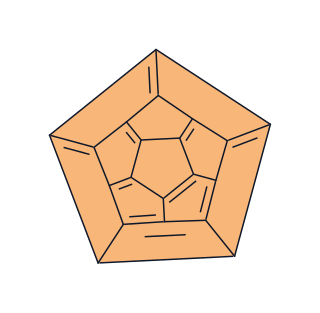
C₂₀
C₂₀ fullerene (dodecahedral cage)
Smallest fullerene: 12 pentagons, no hexagons (Prinzbach 2000)
MolDraw › Library › Carbon materials
27 structures · free to open and edit in MolDraw
C₂₀ fullerene (dodecahedral cage)
Smallest fullerene: 12 pentagons, no hexagons (Prinzbach 2000)
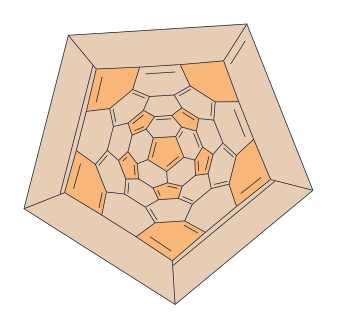
C₇₀ fullerene (D₅ₕ)
Rugby-ball fullerene: C₆₀ halves plus a 10-carbon belt
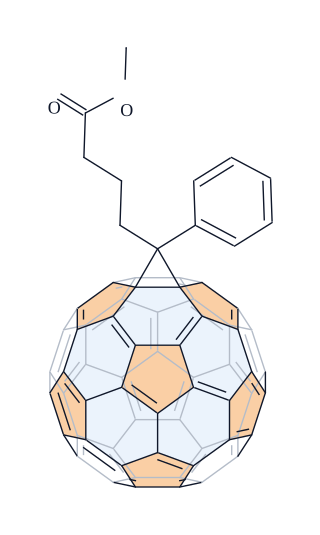
[6,6]-Phenyl-C₆₁-butyric acid methyl ester (PCBM)
Methanofullerene acceptor of bulk-heterojunction solar cells
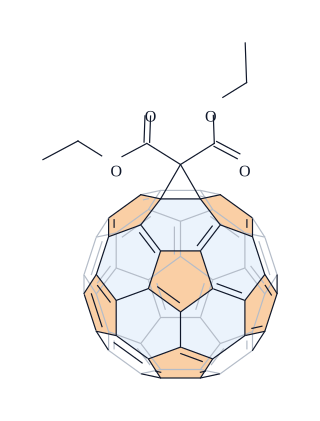
Diethyl 1,2-methano[60]fullerene-61,61-dicarboxylate (Bingel adduct)
Cyclopropanation of a 6,6 bond with diethyl bromomalonate
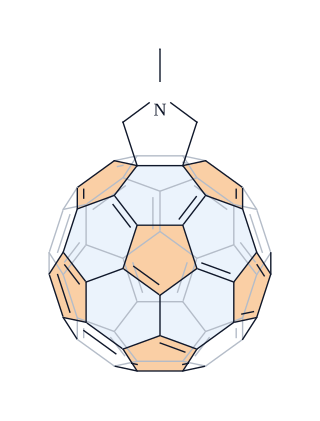
N-Methyl-3,4-fulleropyrrolidine (Prato adduct)
1,3-Dipolar cycloaddition of an azomethine ylide (sarcosine + CH₂O)
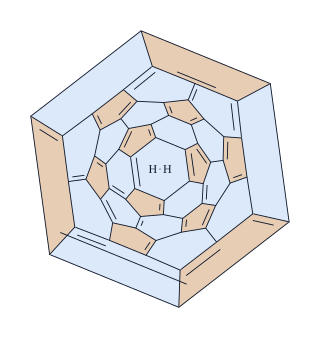
H₂@C₆₀ (endohedral dihydrogen fullerene)
H₂ sealed inside C₆₀ by “molecular surgery”; drawn at the cage centre (not bonded)
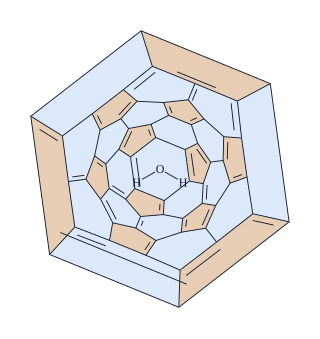
H₂O@C₆₀ (endohedral water fullerene)
A single water molecule trapped in C₆₀; drawn at the cage centre (not bonded)
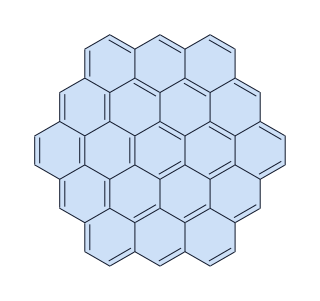
Nanographene: coronene ringed by a second hexagon shell (19 rings)
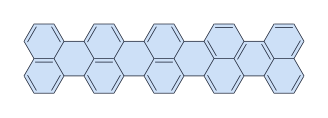
N = 5 armchair graphene nanoribbon segment (model)
Rylene-type ribbon segment, 5 carbon dimer lines wide
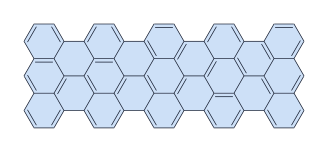
N = 7 armchair graphene nanoribbon segment (model)
Width of the ribbon made from DBBA on Au(111) (Cai 2010)
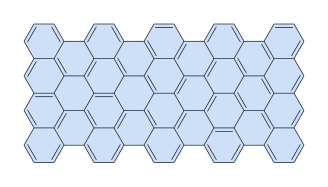
N = 9 armchair graphene nanoribbon segment (model)
Wider armchair ribbon (smaller band gap)
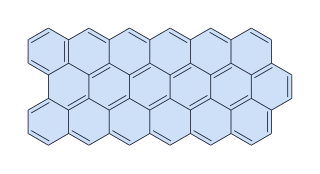
Zigzag graphene nanoribbon segment (N = 4 zigzag chains, model)
Zigzag edges top and bottom (edge states)
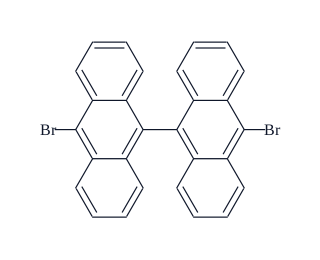
10,10′-Dibromo-9,9′-bianthryl (DBBA)
Monomer for 7-AGNRs: Ullmann coupling, then cyclodehydrogenation
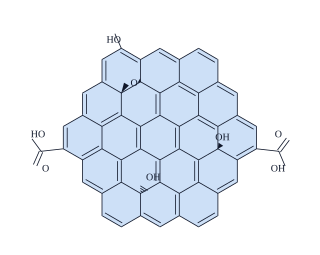
Graphene oxide fragment (Lerf–Klinowski-type model)
Circumcoronene flake with basal epoxide / OH and edge CO₂H — a schematic model, not a defined compound
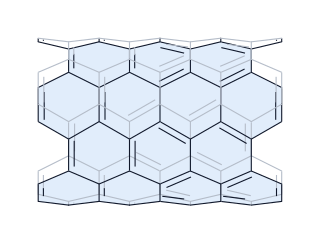
(5,5) Armchair carbon nanotube segment (open, H-terminated)
Short armchair tube segment drawn side-on (back bonds grey); 3D model included
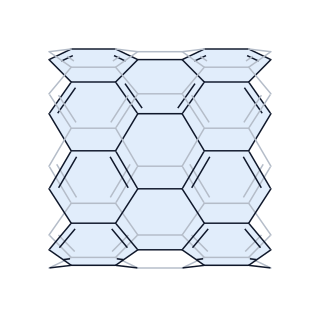
(9,0) Zigzag carbon nanotube segment (open, H-terminated)
Short zigzag tube segment drawn side-on (back bonds grey); 3D model included
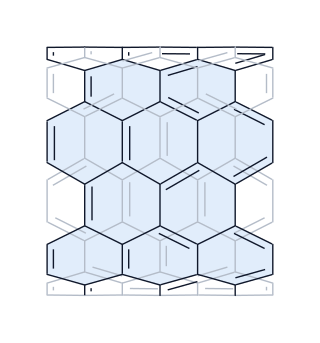
(6,6) Armchair carbon nanotube segment (open, H-terminated)
Wider armchair segment; a stack of [12]CPP-like rings
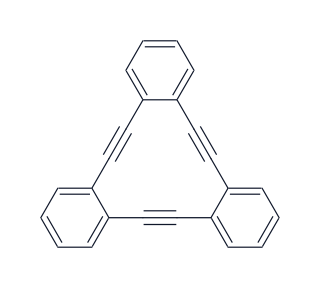
Tribenzo-hexadehydro[12]annulene (graphyne subunit)
Dehydrobenzoannulene repeat motif of γ-graphyne
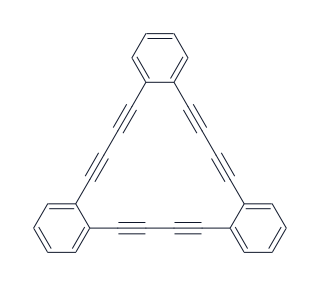
Tribenzo-octadehydro[18]annulene (graphdiyne subunit)
Butadiyne-linked pore of graphdiyne
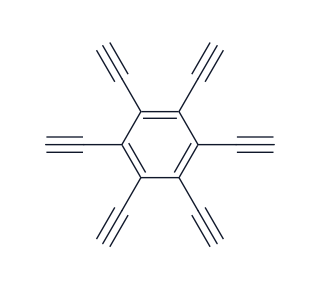
Monomer of graphdiyne films (Glaser coupling on Cu, Li 2010)
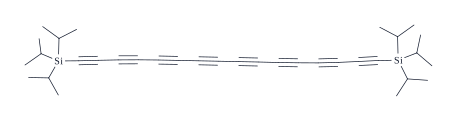
Bis(triisopropylsilyl)hexadecaoctayne (TIPS-capped [8]polyyne)
End-capped polyyne: a finite model of carbyne
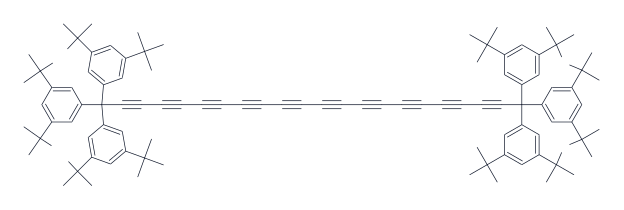
Supertrityl-capped [10]polyyne (Tr*–(C≡C)₁₀–Tr*)
Bulky tris(3,5-di-tert-butylphenyl)methyl caps stabilise long polyynes (up to 22 C≡C)
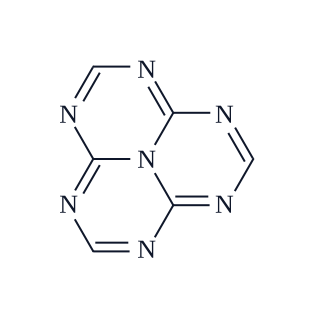
Heptazine (tri-s-triazine, 1,3,4,6,7,9,9b-heptaazaphenalene)
Building unit of graphitic carbon nitride (g-C₃N₄)
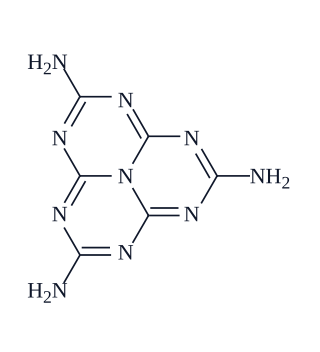
Melem (2,5,8-triamino-tri-s-triazine)
Condensation intermediate on the way from melamine to g-C₃N₄
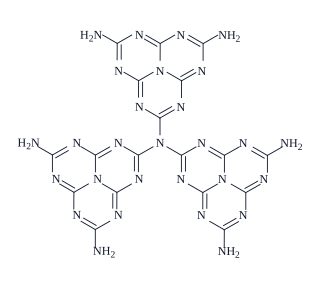
g-C₃N₄ fragment: three heptazines on a central N (model)
Tertiary-N-bridged heptazine trimer; idealised graphitic carbon nitride motif
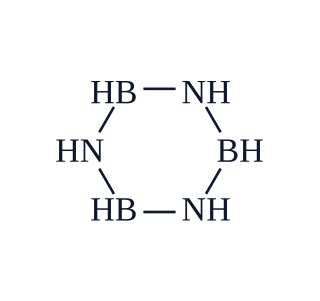
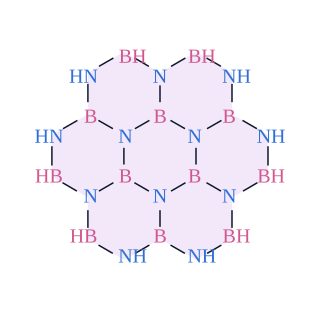
Hexagonal boron nitride flake (B₁₂N₁₂H₁₂, coronene-shaped model)
Alternating B / N honeycomb, H-terminated: “white graphene” fragment